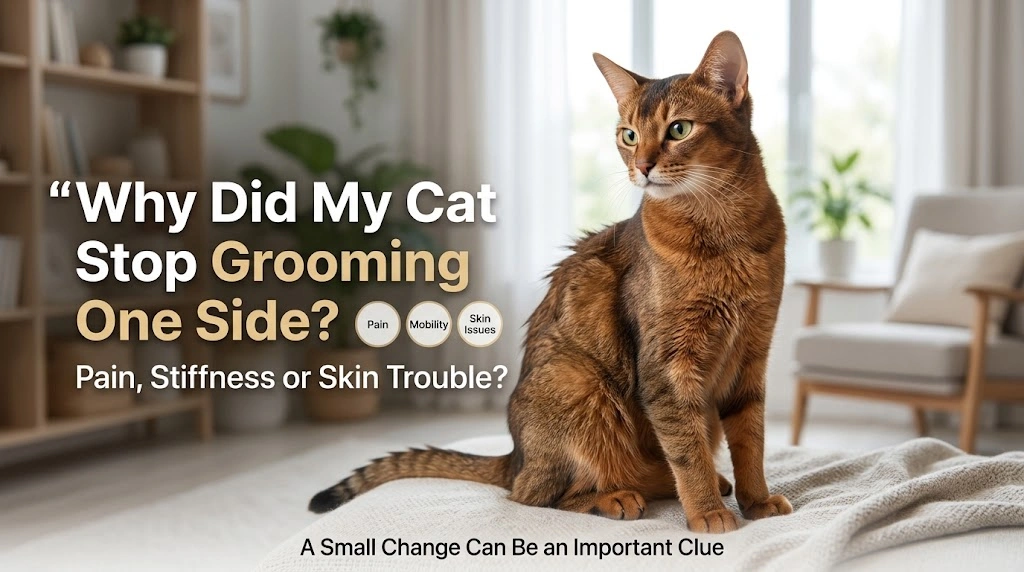
When a cat repeatedly licks one side of the body, the location matters. Cats overgroom for many reasons, but a one-sided pattern makes a local skin problem, flea irritation, wound, painful joint, muscle soreness, or deeper discomfort especially important to consider.
Quick Answer
Part the fur gently if the cat allows it and look for redness, scabs, fleas or flea dirt, hair breakage, swelling, a puncture, moisture, or a tender area. Watch how the cat walks and jumps. Persistent licking that causes hair loss or skin damage should be evaluated. Prompt care is appropriate for swelling, pus, a bite wound, fever, marked pain, or rapid worsening.
Overgrooming vs. Normal Grooming
Normal grooming moves around the body and stops. Overgrooming tends to focus on one spot or region and may leave short broken hairs, bald patches, irritated skin, or a coat that looks wet from saliva. The cat may return to the same place repeatedly even after being distracted.
Fleas and Allergy
Flea bites can cause intense irritation, especially around the lower back, rump, and tail base. Some cats react strongly to only a few bites. Flea dirt can look like tiny black specks. Other allergies can also cause itching, but one-sided licking still warrants checking for a local trigger.
Skin Infection or a Hidden Wound
Bites and scratches can be hidden under fur. A puncture may close at the surface while infection develops beneath it, producing warmth, swelling, pain, and eventually an abscess. Outdoor access or recent fighting increases suspicion.
Pain Can Cause Licking Even When the Skin Looks Normal
Cats sometimes lick over a painful joint, muscle, abdomen, or back. Hip pain, spinal discomfort, arthritis, or soft-tissue injury can produce local grooming even when there is no rash. Watch for stiffness, reluctance to jump, slower movement, or sensitivity to touch.
If mobility is also changing, see Cat Suddenly Cannot Jump.
Hair Loss Helps Show the Duration
Repeated licking can break hair shafts and create smooth or uneven bald areas. If hair loss is the dominant finding, Why Is My Cat Losing Hair? covers parasites, skin disease, grooming behavior, and systemic causes.
Why Location Matters
| Location | Possibilities to consider |
|---|---|
| Tail base/lower back | Fleas, allergy, tail-base pain |
| One hip or thigh | Joint pain, muscle injury, skin disease |
| One flank | Skin irritation, wound, local pain |
| One front leg or paw | Paw injury, nail problem, joint pain |
Do Not Assume Stress Until Physical Causes Are Checked
Stress and compulsive grooming can occur, but they are diagnoses of exclusion when a cat has a focused new grooming pattern. Fleas, pain, wounds, allergy, and infection should be considered first. Calling the behavior “anxiety” too early can delay treatment.
What to Record
- Exact area being licked.
- Whether the skin is red, warm, moist, swollen, scabbed, or bald.
- Any fleas or flea dirt.
- Whether the cat limps or jumps less.
- Recent fights, falls, grooming products, or environmental changes.
- Whether licking occurs mainly after activity or at rest.
What Not to Do
- Do not apply essential oils.
- Do not use human steroid or antibiotic creams unless a veterinarian approves them.
- Do not shave a painful area with scissors close to the skin.
- Do not punish grooming behavior.
What the Veterinarian May Check
The veterinarian may examine the skin and coat, check for parasites, palpate the area for pain or swelling, inspect joints, and look for wounds. Cytology, skin scraping, fungal testing, flea treatment, or imaging may be recommended depending on the pattern.
Related Virixoo Guides
If the skin is flaky or dry rather than bald, Why Does My Cat Have Dandruff? may be useful. If the problem is actually reduced grooming on one side, use Why Does My Cat Suddenly Stop Grooming One Side of Its Body?.
Bottom Line
One-sided licking is a pattern worth localizing. It can come from itch, infection, injury, fleas, or pain under apparently normal skin. Focus on the exact site, the condition of the coat and skin, and whether mobility has changed. Persistent self-trauma deserves veterinary evaluation.