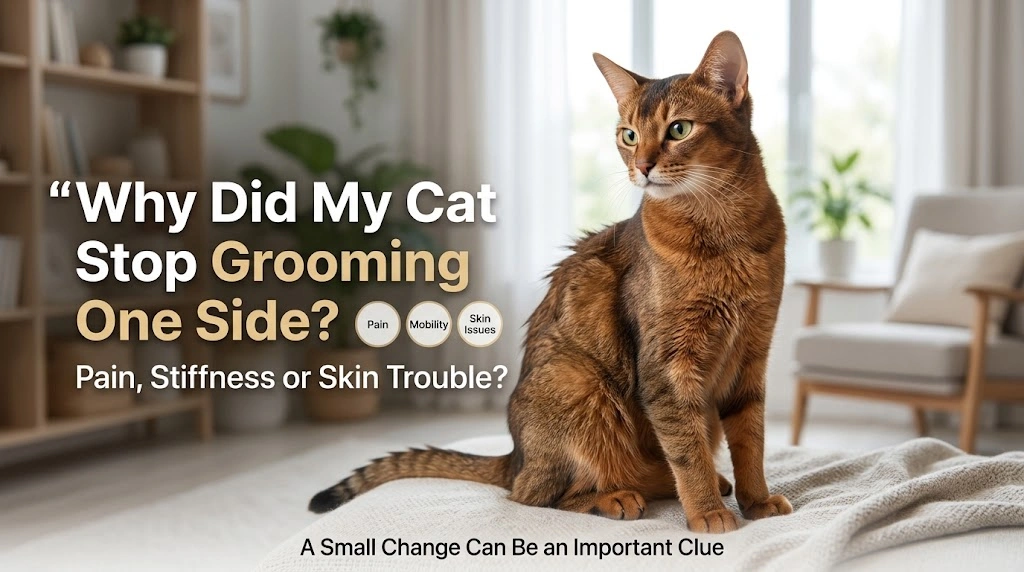
When a normally tidy cat suddenly stops grooming one side of the body, the asymmetry is useful information. Cats usually distribute grooming across reachable areas. A one-sided change can mean that turning, bending, balancing, or touching that side has become uncomfortable. Joint pain, a sore paw, back or neck pain, skin disease, a wound, weakness, obesity, and neurologic problems are among the possibilities.
Quick Answer
Look at which areas are becoming greasy, flaky, matted, or unkempt and compare that with how the cat walks, jumps, turns, and rests. Do not force the cat into grooming positions. Arrange veterinary evaluation if the change is new and persists, especially if it is paired with pain, reduced jumping, limping, weakness, weight loss, or skin lesions. Sudden inability to use one side of the body, severe imbalance, collapse, or major trauma is urgent.
Why Grooming Is Such a Useful Health Clue
Grooming requires flexibility, balance, comfortable joints, normal sensation, and enough energy to bend toward different parts of the body. A cat can still eat and walk while quietly reducing grooming because twisting hurts. Coat changes may therefore appear before an obvious limp.
Map the Ungroomed Area
Notice whether the change affects the lower back, one hip, one flank, one shoulder, or an entire side. A patch over a painful joint suggests a different problem from poor coat care along the whole left or right side. Photographs taken from above every few days can document whether the pattern is spreading.
Arthritis Can Limit Reach
Osteoarthritis is common in older cats and is often expressed through subtle behavior changes rather than obvious limping. Affected cats may avoid stairs, jump less, hesitate to enter a litter box, sleep in lower places, and stop grooming areas that require twisting.
If reduced jumping appears at the same time, see Cat Suddenly Cannot Jump. That article helps separate generalized mobility loss from a coat problem.
Back, Hip, or Shoulder Pain
Muscle strain, spinal pain, hip discomfort, or shoulder pain can make a particular grooming posture unpleasant. A cat that cries when touched, stiffens after sleep, or avoids turning in one direction deserves examination rather than a more aggressive brushing routine.
A Painful Paw Can Change Balance During Grooming
Cats often sit or stand in specific positions to reach the flank and hindquarters. A sore paw, overgrown claw, cracked pad, or limb injury can make those positions unstable. Examine paws visually if the cat allows it, but do not squeeze painful toes.
If claws are staying extended or snagging, Cat’s Claws Won’t Retract is a relevant internal guide.
Skin Pain, Itching, and Wounds
Skin disease can produce either too much grooming or too little. A cat may avoid a sore, infected, or tender area while overgrooming around its edges. Check for redness, scabs, swelling, discharge, fleas, hair loss, mats, or a bite wound. A hidden abscess under dense fur can be very painful.
If hair loss rather than poor coat maintenance is the main problem, compare with Why Is My Cat Losing Hair?.
Why Obesity Usually Causes a Different Pattern
Overweight cats may struggle to reach the lower back and hindquarters, often on both sides. Sudden one-sided grooming loss is less easily explained by body condition alone. If weight has gradually increased, it may contribute, but a new asymmetry still deserves attention.
Neurologic Problems Can Affect Grooming
Weakness, altered sensation, poor coordination, or balance problems can make one side difficult to use. Watch for dragging a paw, knuckling, leaning, falling, head tilt, unequal movement of the face, or difficulty jumping. These findings should shorten the time to veterinary assessment.
Do Not Confuse Poor Grooming With Overgrooming
Overgrooming often leaves hair shortened, broken, or missing. Under-grooming leaves fur greasy, clumped, flaky, or matted because the tongue is not maintaining it. Both patterns can occur in the same cat if one area is itchy while another is painful to reach.
Safe Coat Care While You Investigate the Cause
Use a soft brush only on areas the cat tolerates. Stop if the skin twitches intensely, the cat turns sharply, flattens the ears, growls, or tries to bite. Do not cut tight mats close to the skin with household scissors; feline skin tears easily and can be pulled into the mat.
The guide How to Brush a Cat Without Stress can help with gentle coat support while the medical cause is addressed.
When to Seek Care
| Pattern | Suggested response |
|---|---|
| Minor coat mess after illness or a short interruption in routine, rapidly improving | Gentle grooming and observation |
| Persistent one-sided poor grooming with stiffness or reduced jumping | Veterinary appointment |
| Painful swelling, wound, fever, marked limp, or rapidly worsening coat | Prompt care |
| Sudden one-sided weakness, inability to stand, severe imbalance, collapse | Emergency care |
What the Veterinarian May Check
The veterinarian may examine the skin and coat, joints, spine, paws, body condition, muscle mass, and neurologic function. Depending on the findings, tests might include skin sampling, parasite checks, X-rays, blood work, or additional imaging. Treatment is directed at the reason grooming became difficult, not just at the coat itself.
Bottom Line
A one-sided grooming change can be an early pain or mobility signal. Rather than brushing harder, map the area, watch natural movement, inspect the skin and paws without forcing the cat, and seek veterinary advice if the asymmetry persists. Restoring comfortable movement usually matters more than simply making the coat look tidy.