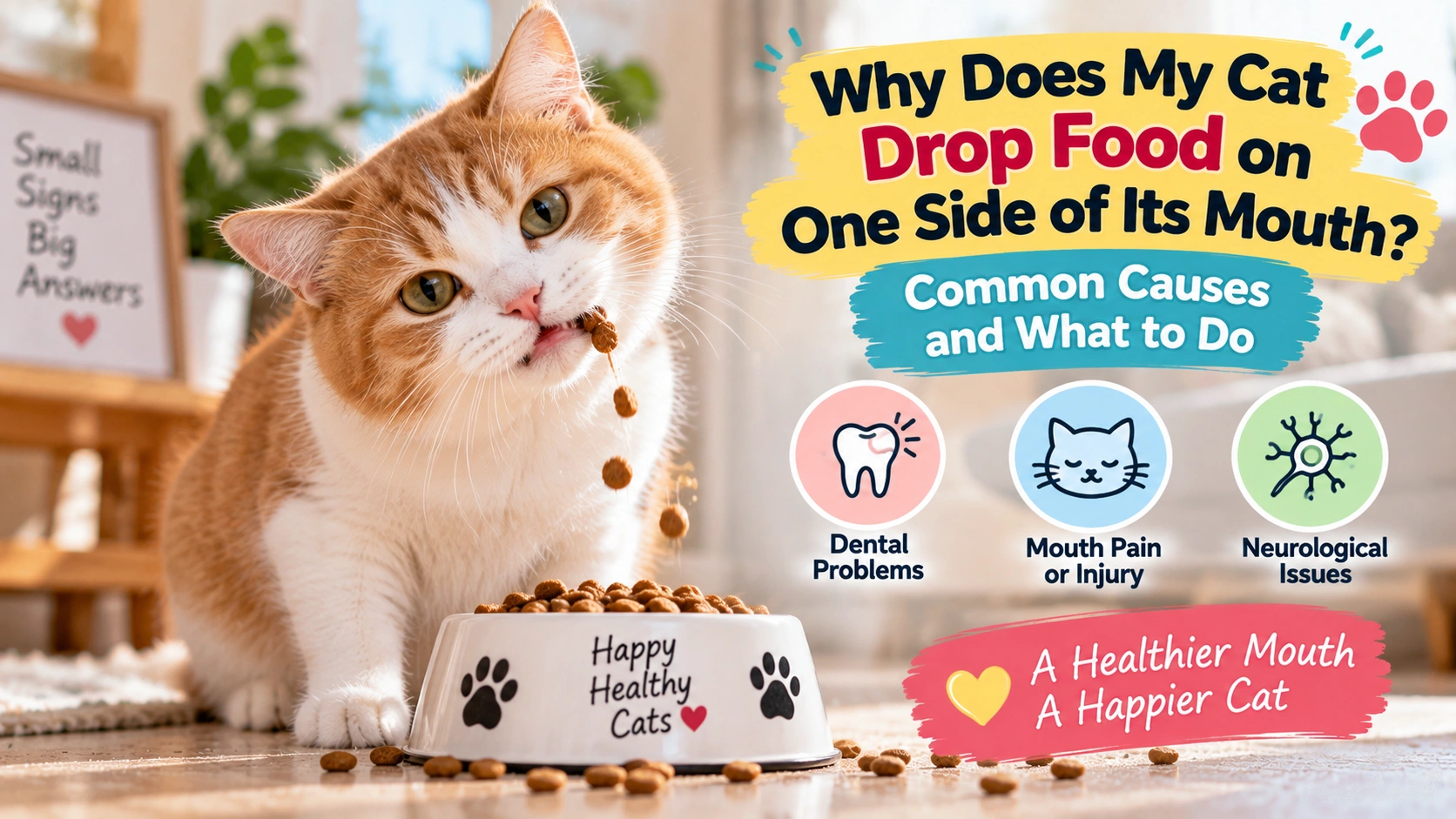
When kibble repeatedly falls from one side of a cat’s mouth, the pattern points more strongly toward an oral or mechanical problem than a simple appetite change. Painful teeth, tooth resorption, inflamed gums, a fractured tooth, oral ulcers, a mass, jaw pain, or abnormal tongue or facial movement can interfere with grasping and chewing food normally.
Quick Answer
Do not assume your cat is being messy if this is new. Watch which side is used for chewing, whether the head tilts, and whether there is drooling, bad breath, pawing at the mouth, blood, facial swelling, or a preference for soft food. Arrange a veterinary dental examination when food repeatedly falls from one side. Seek prompt care if the cat cannot eat, cannot close the mouth, has major facial swelling or trauma, or develops difficulty swallowing or breathing.
Why One-Sided Food Dropping Is Useful
A general appetite problem often reduces interest in the whole meal. One-sided food loss is more specific: the cat may be trying to avoid pressure on a painful tooth or may be unable to control food normally on that side. Some cats keep eating enthusiastically despite substantial dental pain.
Tooth Resorption Is an Important Possibility
Tooth resorption is common and can be extremely painful. Cornell describes cats with resorptive lesions as sometimes tilting the head, chewing on one side, swallowing kibble without much chewing, or allowing food to fall from the mouth. These signs can occur even before the cat stops eating.
A full dental examination and dental radiographs are important because much of the disease can lie below the gum line.
Broken or Chipped Teeth
A fractured tooth may expose painful internal tissue or become infected. The visible chip can be small even when the deeper damage matters. Cats may shift chewing to the opposite side, slow down, or drop hard food.
See Broken or Chipped Tooth in Cats if a damaged tooth is visible. Do not poke the fracture or test it with a hard object.
Gingivitis, Periodontal Disease, and Stomatitis
Inflamed gums or deeper periodontal disease can make chewing uncomfortable. Severe stomatitis can make opening the mouth and moving food backward painful. Look for red gums, drooling, foul odor, bleeding, or a cat that approaches food but suddenly recoils after biting.
If bad breath is one of the strongest clues, use Why Does My Cat Have Bad Breath?.
Oral Ulcers or Masses
Ulcers on the tongue, gums, or inner cheek can interfere with comfortable chewing. Oral masses can also change how the tongue and jaw handle food. Persistent bleeding, facial asymmetry, unexplained weight loss, worsening odor, or a visible growth deserves prompt evaluation.
Jaw or Tongue Dysfunction
Trauma, jaw joint problems, nerve dysfunction, or abnormal tongue control can allow food to escape from one side. If the jaw looks crooked, the mouth cannot close, or the tongue suddenly hangs out, this is more urgent than ordinary dental disease.
Related Virixoo guides include Cat Cannot Close Its Mouth and Cat’s Tongue Suddenly Hanging Out.
Why Soft Food May Seem Easier
A painful cat may lick soft food while avoiding the force needed to crack kibble. That does not prove the problem is a tooth, but a sudden preference for soft food is a useful clue. Do not use the easier texture as a reason to postpone examination when one-sided chewing persists.
What to Observe Without Opening the Mouth
- Which side the cat tilts its head toward while chewing.
- Whether kibble falls from the same side every time.
- Whether soft food is handled more easily.
- Drooling, bad breath, blood, or swelling.
- Whether the cat can pick up food normally with the tongue and lips.
- Whether meal time is getting longer.
- Weight loss or reduced daily intake.
A short video of the cat eating a normal meal can be very useful and is safer than forcing a mouth examination.
What Not to Do
- Do not probe a sore tooth or gum.
- Do not brush painful inflamed gums before a veterinarian evaluates them.
- Do not give human pain medicine.
- Do not rely on dental treats to treat existing dental disease.
- Do not wait for complete food refusal before seeking help.
When It Needs Faster Care
| Finding | Suggested response |
|---|---|
| One isolated messy meal, then normal chewing | Observe the next meals |
| Repeated one-sided food dropping or head tilting | Schedule a dental examination |
| Drooling, blood, facial swelling, marked pain, weight loss | Prompt veterinary care |
| Cannot close mouth, cannot swallow, major trauma, breathing difficulty | Emergency care |
What the Veterinarian May Do
The veterinarian may first perform a conscious oral examination, but a complete dental diagnosis often requires anesthesia, probing, charting, and full-mouth dental radiographs. This is especially important for tooth resorption and disease hidden below the gum line. Suspicious oral tissue may require biopsy or additional imaging.
Bottom Line
Repeatedly dropping kibble from one side is not just a feeding quirk when it begins suddenly. It is a practical clue that chewing or food control may be painful or mechanically abnormal. Dental disease is common in cats, and early examination can prevent prolonged hidden pain. Watch the side, texture preference, odor, drooling, and total intake, and have persistent one-sided eating changes evaluated.