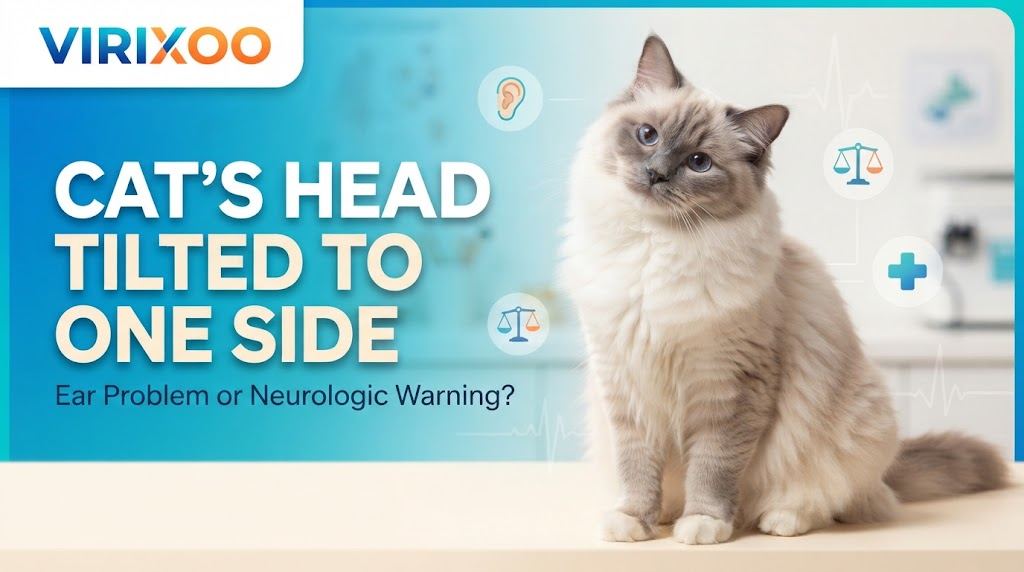
A persistent head tilt is different from the brief curious head-cock seen during play. A cat that continuously holds the head to one side may have a problem affecting the inner ear, vestibular system, or nervous system.
A New Head Tilt Deserves Veterinary Assessment
A new head tilt should not be ignored. Some cats have ear disease or vestibular dysfunction, while others have trauma or neurologic disease. Prompt veterinary assessment is appropriate, especially if the cat is also falling, rolling, vomiting, unable to stand, or showing rapid eye movements.
Common Causes of Head Tilt
- Ear disease, especially middle or inner ear problems.
- Vestibular syndrome, which affects balance.
- Trauma involving the head or ear region.
- Inflammation, tumors, or other neurologic disease.
Signs Often Seen Together
Many cats with vestibular problems show loss of balance, leaning, circling, falling, nausea, vomiting, or rapid side-to-side eye movements. Some cats also hold one ear differently or seem painful when the head is touched.
Why the Pattern Matters
A head tilt with intense ear scratching may point toward ear disease. A head tilt with facial asymmetry, severe weakness, collapse, or altered mental status raises stronger neurologic concern. A history of trauma changes the urgency as well.
Urgent Red Flags
| Finding | What it suggests |
|---|---|
| Unable to stand or repeated falling | Prompt to emergency evaluation |
| Seizures, collapse, or marked mental change | Emergency neurologic concern |
| Severe pain or major trauma history | Urgent assessment |
| Rapid worsening over hours | Do not watch at home |
| Persistent vomiting or dehydration | Prompt care |
What Owners Can Do at Home
Confine the cat to a safe low area, keep the path to food and the litter box simple, and reduce climbing opportunities. If the cat is off balance, stairs and high furniture may increase injury risk.
What Not to Do
Do not put objects deep into the ear canal, do not give leftover ear medication, and do not assume the cat is just dizzy from something minor. A cat may look stable at first and still need treatment.
What the Vet May Evaluate
The veterinarian may check the ear canals, eardrum area, eye movements, facial nerve function, gait, and pain response. Some cats require imaging or further neurologic workup depending on findings.
Balance Signs Need Context and an Exam
A persistent head tilt is an important clinical sign. Ear disease is common, but balance and neurologic disorders must also be considered, especially when the cat is falling, weak, or mentally different from normal.
The direction of the tilt does not diagnose the cause
A head tilt can occur with problems affecting the inner or middle ear, the vestibular nerves, or parts of the brain. Owners may also notice falling, circling, nausea, or rapid involuntary eye movements. Those signs can look dramatic even when the eventual cause is treatable, but they still justify prompt veterinary assessment.
Prevent falls while the cat is unsteady
Use a small room with good footing, block stairs, lower food and water temporarily, and keep the litter box easy to enter. Do not force the cat to walk to “test” its balance. If vomiting or motion sickness is severe, transport the cat in a padded carrier and call the clinic for instructions.
Ear discharge, odor, facial droop, or pain may point attention toward ear disease, while weakness, altered awareness, seizures, or severe neurologic changes raise concern for central causes. The examination is what separates them.
Related Virixoo Guides
Read why a cat may hold one ear lower. Read why a cat may suddenly fall over. Read why a cat may resist turning the head one way.