
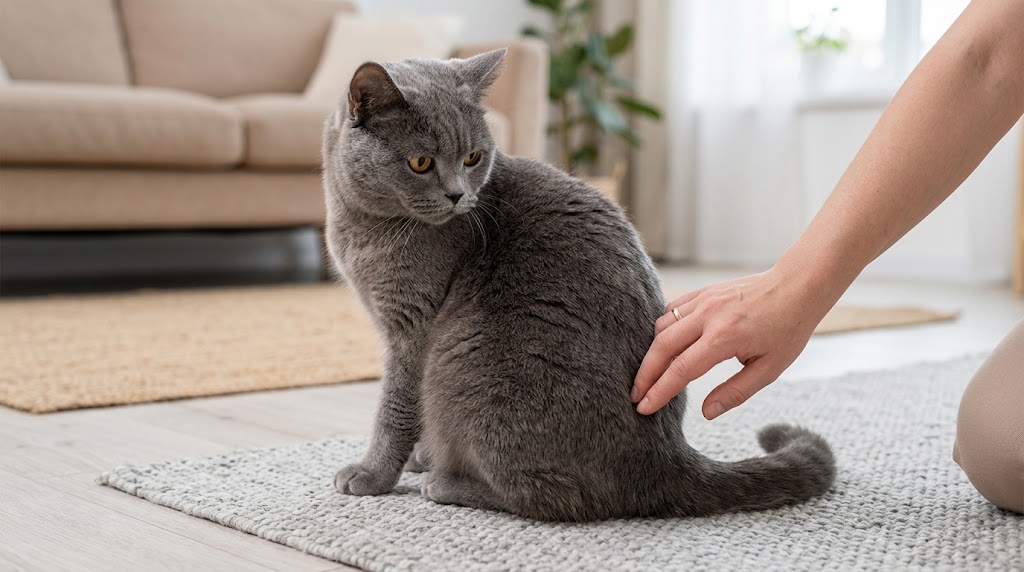
If your cat suddenly cries, flinches, turns to bite, or moves away when the lower back is touched, treat the reaction as possible pain rather than bad behavior. The discomfort may come from skin, muscles, joints, the spine, the pelvis, or the base of the tail. The exact location and the way your cat moves before and after being touched can help separate a superficial skin problem from deeper musculoskeletal or neurologic pain.
Quick Answer
Stop pressing or repeatedly “testing” the sore spot. Watch your cat walk, jump, use the litter box, groom, and move the tail naturally. A new painful reaction that persists should be examined by a veterinarian. Seek prompt care after a fall, bite, door injury, or tail pull, and seek urgent care if lower-back pain is accompanied by hind-leg weakness, inability to stand, loss of bladder control, inability to urinate, a cold limb, collapse, or severe distress.
First Decide Whether the Pain Is in the Skin or Deeper
Part the fur visually if the cat allows it and look for a scab, swelling, puncture, mat, redness, flea dirt, hair loss, or a moist sore. A painful skin lesion can make the whole lower back seem sensitive. A bite abscess may begin as a small hidden puncture and later become warm, swollen, and very painful.
If the skin looks normal but the cat is stiff, avoids jumping, moves the tail differently, or struggles to get comfortable, deeper pain becomes more likely.
Arthritis and Joint Pain Can Make Petting Uncomfortable
Feline arthritis is often subtle. Cats may still walk without an obvious limp while becoming reluctant to jump, use stairs, climb into a high-sided litter box, or tolerate touch over the hips and lower spine. Some begin sleeping in lower places or grooming the back less thoroughly because twisting hurts.
For a broader mobility pattern, see Cat Suddenly Cannot Jump. That guide focuses on reduced jumping ability, while this article focuses on pain specifically triggered by touching the lower back.
Muscle Strain or Soft-Tissue Injury
An awkward landing, vigorous play, a slip on a smooth floor, or a minor fall can strain muscles around the back, hips, or pelvis. The cat may move almost normally until turning, jumping, or being touched in one direction. Because fractures and more serious injuries can initially look similar to a strain, a sudden painful reaction after trauma should not be diagnosed at home.
Tail-Base Injury and Nerve Concerns
The tail base is close to nerves involved in tail, bladder, and bowel function. A tail-pull injury, door accident, or other trauma can cause severe pain even when there is little visible swelling. A tail that suddenly hangs limp, urine leakage, straining to urinate, or hind-limb weakness increases concern for nerve damage.
If tail movement changed, compare the pattern with Cat’s Tail Suddenly Limp. Do not pull, bend, or lift the tail repeatedly to test it.
Skin Disease and Flea-Related Irritation
The lower back and tail base are common places for flea-related skin irritation to become obvious. Scabs, intense licking, chewing, hair thinning, and skin twitching may accompany sensitivity. Other allergies, infections, wounds, or mats can also make touch painful.
If hair loss is the dominant change, Why Is My Cat Losing Hair? explains how grooming, parasites, skin disease, and other causes can create different patterns.
What About Rippling Skin or Sudden Back Twitching?
Some cats normally ripple the skin when touched. A stronger reaction can also occur with skin irritation or pain. Rarely, cats have episodes of marked sensitivity, agitation, tail chasing, dilated pupils, and dramatic skin rippling that need veterinary assessment. Do not label this as a specific syndrome based on one twitch; first rule out pain, fleas, wounds, and orthopedic disease.
Observe Movement Instead of Provoking Pain
Let the cat move on its own. Useful observations include whether it:
- rises smoothly after sleep;
- walks with a shortened stride;
- hesitates before jumping or going down stairs;
- holds the back rounded or unusually flat;
- uses both hind legs symmetrically;
- moves the tail normally;
- enters and exits the litter box comfortably;
- grooms the lower back and hindquarters as usual.
A video of natural walking is safer and often more informative than repeatedly touching the sore area.
How Urgent Is Lower-Back Pain?
| Finding | What to do |
|---|---|
| Mild sensitivity once, then completely normal behavior | Observe closely and avoid repeated pressure |
| Persistent pain with stiffness, reduced jumping, or grooming changes | Arrange a veterinary appointment |
| Swelling, bite wound, fever, marked limp, or pain after trauma | Prompt examination |
| Hind-limb paralysis, inability to urinate, collapse, severe trauma | Emergency care |
What You Can Do Until the Appointment
Keep the cat indoors in a quiet room with food, water, and a low-entry litter box nearby. Reduce access to high furniture and slippery surfaces. Let the cat choose a comfortable resting position. If there is a superficial wound, do not apply human creams, essential oils, or pain gels unless a veterinarian has specifically recommended a product.
Do Not Give Human Pain Medication
Acetaminophen, ibuprofen, naproxen, and many other human pain relievers can be dangerous or fatal to cats. Pain control should be selected by a veterinarian based on the cause, age, kidney function, hydration, and other medications.
What the Veterinarian May Examine
The veterinarian may palpate the spine, hips, pelvis, tail, muscles, and abdomen and perform an orthopedic and neurologic examination. Skin lesions may require clipping, cytology, parasite testing, or treatment for an abscess. Trauma or neurologic findings may lead to X-rays or additional imaging. In older cats, the pattern may support assessment for osteoarthritis and other chronic disease.
Bottom Line
A cat that cries when the lower back is touched is communicating discomfort. The safest response is to stop provoking the reaction, observe natural movement and litter-box function, and arrange evaluation if the pain is new or persistent. Trauma, tail dysfunction, hind-leg weakness, or urinary changes increase urgency because the problem may involve more than a sore muscle.