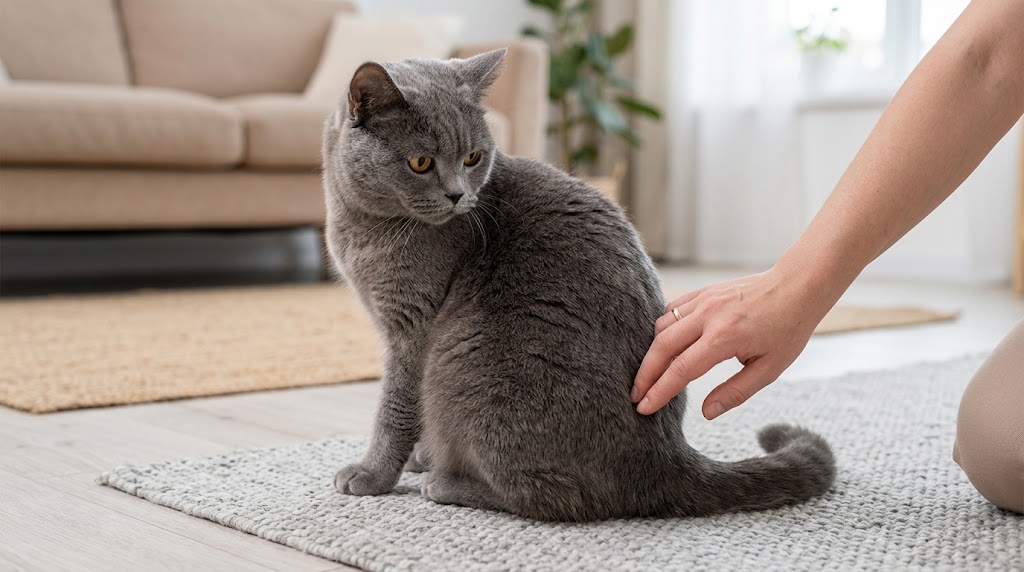

A cat that can jump up normally but cries when jumping down may be reacting to the impact of landing rather than to the push-off itself. Landing places force through the front paws, wrists, elbows, shoulders, spine, and hindquarters in a different way from jumping upward. Paw injuries, arthritis, soft-tissue strain, back pain, and other orthopedic problems can therefore show up mainly on the way down.
Quick Answer
Stop encouraging test jumps. Let the cat choose low routes and observe normal walking, stairs, resting posture, and paw use. A new cry on landing that repeats should be evaluated by a veterinarian. Seek prompt care for a non-weight-bearing limb, swelling, a torn claw, obvious trauma, or severe pain. Sudden paralysis, a cold painful limb, collapse, or inability to stand is an emergency.
Why Jumping Down Can Hurt More Than Jumping Up
Jumping up depends heavily on propulsion from the hind legs. Jumping down requires the body to absorb impact, especially through the forelimbs and spine. A cat with an early elbow, shoulder, wrist, paw, or spinal problem may still generate enough power to jump upward but react when landing compresses a painful area.
Look at the Landing, Not Just the Cry
Watch from a distance. Does the cat land evenly on both front paws? Does one paw lift immediately? Does the cat hesitate at the edge, choose shorter drops, land stiffly, or shake a paw afterward? A short spontaneous video can be valuable. Do not repeatedly place the cat on furniture to reproduce the sign.
Paw and Claw Problems
A cracked pad, puncture, torn claw, overgrown nail, or foreign material can hurt most when the paw takes impact. Compare the paws visually and look for swelling, bleeding, a claw caught at an abnormal angle, or repeated licking.
If claws are remaining extended or catching on fabric, see Cat’s Claws Won’t Retract.
Forelimb Joint Pain
Arthritis or injury in the wrist, elbow, or shoulder can make landing painful while walking remains almost normal. Cats often hide joint pain, so owners may first notice small changes: taking a longer route, using intermediate furniture, pausing before a drop, or vocalizing only during one movement.
Back and Neck Pain
The spine also absorbs force during landing. A cat with spinal or muscle pain may cry, crouch after landing, hesitate to turn, or become sensitive to touch over the back. Avoid pressing along the spine to find the exact spot.
Could It Still Be Arthritis if the Cat Jumps Up?
Yes. Arthritis does not affect every movement equally. Early disease can produce pain only during particular loading patterns. A cat may continue reaching a favorite bed but avoid jumping off it. This is one reason “still able to jump” does not rule out pain.
For broader loss of jumping ability, see Cat Suddenly Cannot Jump. The two search intents are different: this article is specifically about pain on descent or landing.
Recent Slips and Minor Trauma
A cat that recently slipped on tile, missed a landing, was stepped on, or fell may have a sprain, muscle strain, or fracture. Cats can bear weight despite some fractures, so normal walking alone does not prove that the injury is minor.
Home Changes That Reduce Repeated Impact
- Place a stable step or ottoman beside favorite furniture.
- Use non-slip rugs on smooth floors.
- Keep food, water, and litter on the same level temporarily.
- Block access to very high shelves or ledges.
- Use a low-entry litter box if stepping over the wall seems painful.
These adjustments reduce repeated impact but do not replace diagnosis if pain persists.
How to Judge Urgency
| Finding | Response |
|---|---|
| One brief vocalization after an awkward landing, then completely normal | Restrict high jumps and observe closely |
| Repeated crying on descent, hesitation, stiffness, or reduced activity | Book a veterinary exam |
| Swelling, torn claw, non-weight-bearing limb, obvious injury | Prompt veterinary care |
| Sudden paralysis, cold painful limb, collapse, inability to stand | Emergency care |
What Not to Do
- Do not force repeated jumps to locate the problem.
- Do not massage a recently injured area aggressively.
- Do not splint or tightly bandage a limb without veterinary guidance.
- Do not give human pain medication.
What the Veterinarian May Check
The examination may include each paw, claw, wrist, elbow, shoulder, hip, knee, spine, and neurologic function. The veterinarian will compare range of motion and pain responses rather than relying only on the owner’s description of the jump. X-rays or other imaging may be recommended if trauma, arthritis, or spinal disease is suspected.
What Improvement Should Look Like
Improvement means more than the cat becoming quieter. It should land more evenly, hesitate less, resume normal routes, groom normally, and remain comfortable after rest. If vocalization stops only because the cat avoids jumping altogether, pain may still be present.
Bottom Line
Crying specifically when jumping down can reveal impact-related pain that is not obvious during walking or jumping up. Protect the cat from repeated high landings, watch which limb or movement changes, and arrange veterinary assessment if the pattern repeats. Landing pain is a useful symptom, not a behavior to train away.