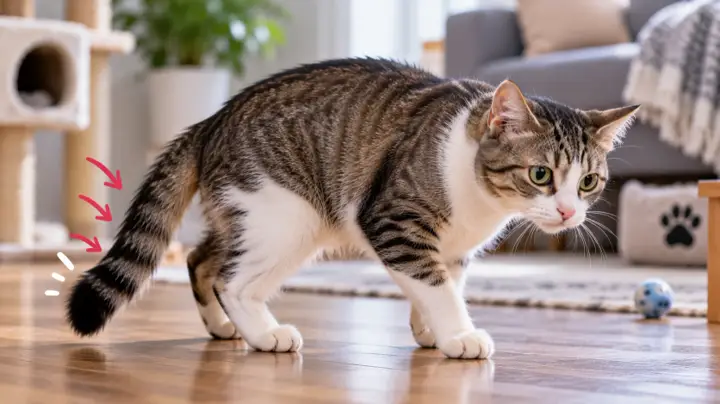

A tail that suddenly hangs limp or moves abnormally can reflect trauma, fracture, dislocation, pain, or nerve injury. Problems near the tail base deserve extra attention because the same region contains nerves that help control bladder and bowel function.
A Limp Tail Can Involve More Than the Tail
If your cat’s tail suddenly becomes limp, painful, or difficult to move, veterinary assessment is appropriate. Urgent care is especially important if the cat cannot urinate normally, leaks urine, loses anal tone, or appears weak in the hindquarters.
Common Causes
- Tail-pull injury or other trauma
- Fracture or dislocation
- Soft-tissue injury or bruise
- Nerve damage, especially near the base of the tail
Signs That Help Judge Severity
Some cats only resist touching the tail, while others show a completely flaccid tail, pain near the rump, abnormal gait, urine leakage, or constipation. A cat that cannot lift the tail and also has trouble urinating needs prompt care.
What to Watch For
| Finding | Why it matters |
|---|---|
| Severe pain or obvious deformity | Possible fracture or dislocation |
| No tail movement at all | Could reflect nerve injury |
| Difficulty urinating or leaking urine | Possible nerve involvement |
| Loss of stool control | Needs prompt evaluation |
| Weak hind legs | More than a simple tail injury may be present |
What You Can Do While Waiting
Restrict activity, keep the cat indoors, and avoid pulling, bending, or testing the tail repeatedly. Use a carrier for transport, especially if the cat is painful.
What Not to Do
Do not try to splint the tail, do not manipulate a painful base injury, and do not assume the problem is minor if the cat is still walking. Tail-base nerve injuries can be more serious than the tail alone suggests.
What the Veterinarian May Examine
The veterinarian may assess pain, tail movement, sensation, anal tone, bladder size, and hind-limb function. X-rays may be recommended if fracture or dislocation is suspected.
Tail Function, Pain and Urination Belong in the Same Assessment
A limp tail may be a localized injury, but the main question is whether nearby nerves are also affected. Changes in urination, bowel control, or hind-limb function make the problem more urgent.
Check urination and hind-leg function, not just the tail
The nerves near the base of the tail are close to nerves involved in bladder and bowel function. After a tail-pull injury or trauma, inability to urinate, urine leakage, weakness in the back legs, or loss of anal tone can be more important than whether the tail itself moves.
Handle as little as possible after trauma
Do not bend, pull, or repeatedly lift a painful tail to see whether it works. Keep the cat confined, prevent jumping, and use a carrier for transport. Visible wounds, severe pain, bleeding, or a tail that became limp after being caught in a door or pulled should be evaluated promptly.
If the tail became weak without known trauma, note any change in walking, urination, defecation, or sensation around the hindquarters. Those details help the veterinarian decide whether the problem is local to the tail or part of a wider nerve or spinal problem.
Related Virixoo Guides
Read why a cat’s tail may drop while walking. Read why a cat may avoid touch near the tail base. Read why a cat may take longer to get into the litter box.