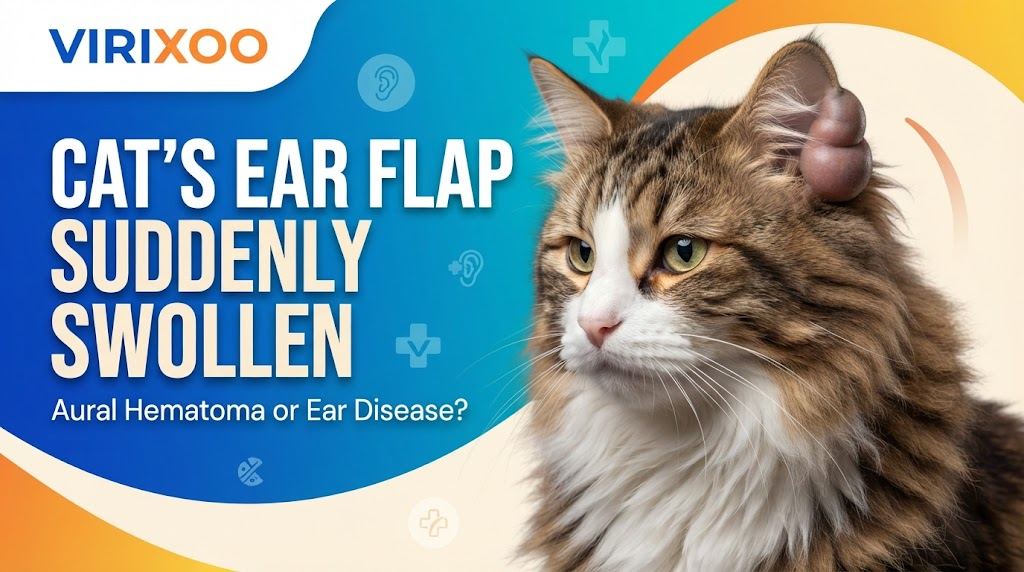
A suddenly thick, puffy, or fluid-filled ear flap often suggests an aural hematoma. This happens when blood collects between tissue layers, usually after head shaking or scratching damages small blood vessels.
A Balloon-Like Ear Flap Is Often a Hematoma, but the Cause Still Matters
If your cat’s ear flap suddenly looks swollen like a pillow or water balloon, veterinary evaluation is recommended. The swelling itself may not be the only problem: an ear infection, mites, allergy, or trauma may be causing the head shaking and scratching that led to the hematoma.
What an Aural Hematoma Usually Looks Like
The ear flap may feel soft and fluctuant, partly or fully thickened, and warmer than normal. Some cats also hold the ear lower, resist touch, or shake the head repeatedly.
Underlying Causes to Look For
- Ear irritation such as infection or mites
- Allergic skin disease
- Trauma from a fight or accident
- Self-trauma from vigorous scratching
When It Is More Urgent
| Finding | Why it matters |
|---|---|
| Severe pain or fever | Prompt care needed |
| Draining wound or foul odor | Could indicate infection or bite injury |
| Major trauma to head or face | Urgent assessment |
| Repeated violent head shaking | Underlying ear disease needs treatment |
| Rapidly enlarging swelling | Prompt evaluation is appropriate |
Why Treatment Matters
If the blood pocket is left alone, the ear can scar and crumple as it heals. More importantly, the original reason for head shaking must be found or the problem often recurs.
What Not to Do
Do not puncture or drain the ear at home, and do not use leftover ear medication. Home drainage risks pain, infection, and incomplete treatment.
What the Veterinarian May Do
The veterinarian may examine the ear canal, check for parasites or infection, and recommend drainage or surgery depending on severity. The best option varies with the size of the hematoma and the cat’s comfort.
Treat the Ear Flap and the Reason It Swelled
A swollen ear flap is commonly an aural hematoma, but successful treatment depends on managing both the swelling and the underlying ear irritation or trauma that caused it.
The swollen flap is often the result of another ear problem
An aural hematoma forms when blood collects within the ear flap, often after vigorous scratching or head shaking. Ear mites, infection, allergy, irritation, or trauma can be the trigger. Treating only the pocket of blood without finding the reason for the scratching makes recurrence more likely.
Do not puncture or drain the ear at home
Home drainage can introduce infection, cause pain, and usually does not address the space that continues to refill. The veterinarian may examine the ear canal, look for parasites or infection, and discuss options for the hematoma based on its size, age, and the cat’s comfort.
Seek faster care if the cat is very painful, the ear canal is obstructed, there is foul discharge, the cat has a head tilt or balance problem, or the swelling followed significant trauma.
Related Virixoo Guides
Read why a cat may hold one ear lower. Read why a cat may tilt the head to one side. Read why a cat may resist turning the head one way.