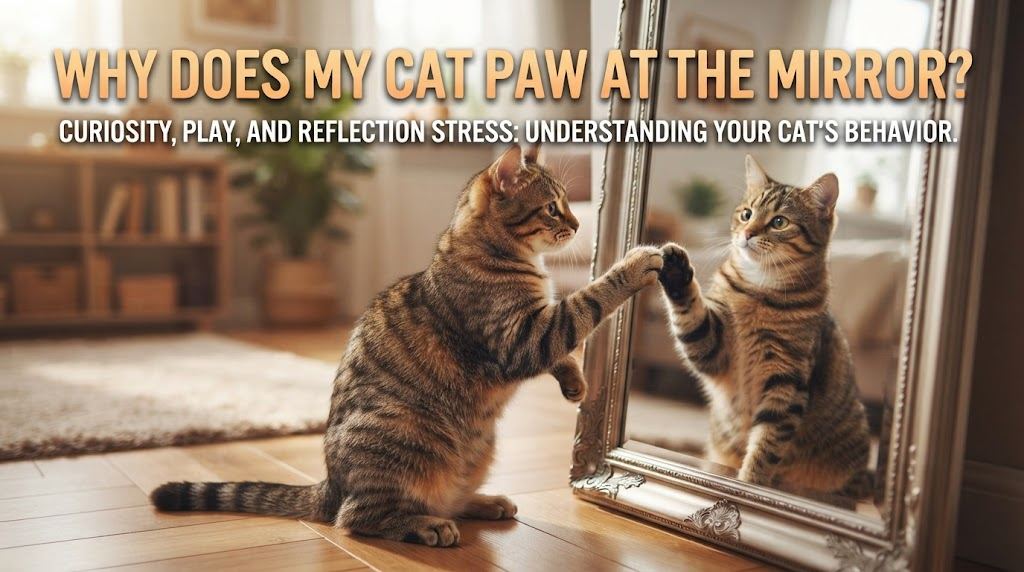
A mirror gives a cat an unusual combination of cues: visible movement that perfectly follows the cat, but none of the normal smell, sound or physical access that would accompany another animal. Some cats ignore that mismatch; others investigate it repeatedly.
Quick Answer
Pawing at a mirror is usually curiosity, play or investigation of movement. What matters is the rest of the body. Gentle tapping, sniffing and looking behind the mirror are different from growling, hissing, a puffed tail, repeated charging or refusing to enter the room.
Why Reflections Can Be Interesting
Cats use vision together with scent, sound and movement when investigating their environment. A reflection provides strong visual movement but lacks many other expected cues. The cat may touch the surface, look behind it, move side to side, or return repeatedly as it tests what the image does.
It is safer to describe this as investigation than to claim we know exactly what the cat thinks the reflection represents.
Playful Pawing Looks Different From Defensive Pawing
| Relaxed investigation | Possible stress or defensive arousal |
|---|---|
| Loose body and neutral ears | Stiff body or crouching |
| Gentle taps or sniffing | Forceful swatting or repeated charging |
| Cat can walk away easily | Fixation that is difficult to interrupt |
| No growling or hissing | Growling, hissing or tail puffing |
| Interest fades with time | Cat avoids the area or remains agitated |
Lighting Can Change the Experience
Reflections can become more obvious at particular times of day. Low indoor light with a brighter area behind the cat, moving sunlight, television light or reflections from windows can make a mirror suddenly more stimulating. If the behavior happens only at certain times, look at what is changing in the room.
Do Not Force a Cat to “Meet” Its Reflection
Holding a cat in front of a mirror or repeatedly moving it closer can remove the cat's ability to choose distance. If your cat looks tense, let it leave. Cats cope better when they can control approach and retreat.
How to Reduce Mirror Fixation
- Temporarily cover the lower part of the mirror if the cat becomes distressed.
- Move a freestanding mirror if reflections are creating repeated arousal.
- Provide interactive play away from the mirror.
- Avoid rewarding loud nighttime scratching with an exciting reaction.
- Protect unstable mirrors so they cannot tip or break.
When the Behavior Needs a Broader Look
Mirror interest by itself is usually harmless. Pay more attention when a sudden fixation appears with disorientation, persistent vocalization, sleep changes, aggression, or other new behavior—especially in a senior cat. In that situation, the important issue is the overall change, not the mirror alone.
Related Virixoo Guides
If your cat frequently tests objects with its paws, read why cats knock things over. For interpreting a fixed look in other contexts, see how to read a cat's stare.
Bottom Line
Most mirror pawing is a form of investigation or play. Read the whole body rather than assuming the reflection has one fixed meaning. If the mirror produces repeated fear or agitation, reduce access to the reflection and give your cat control over distance.