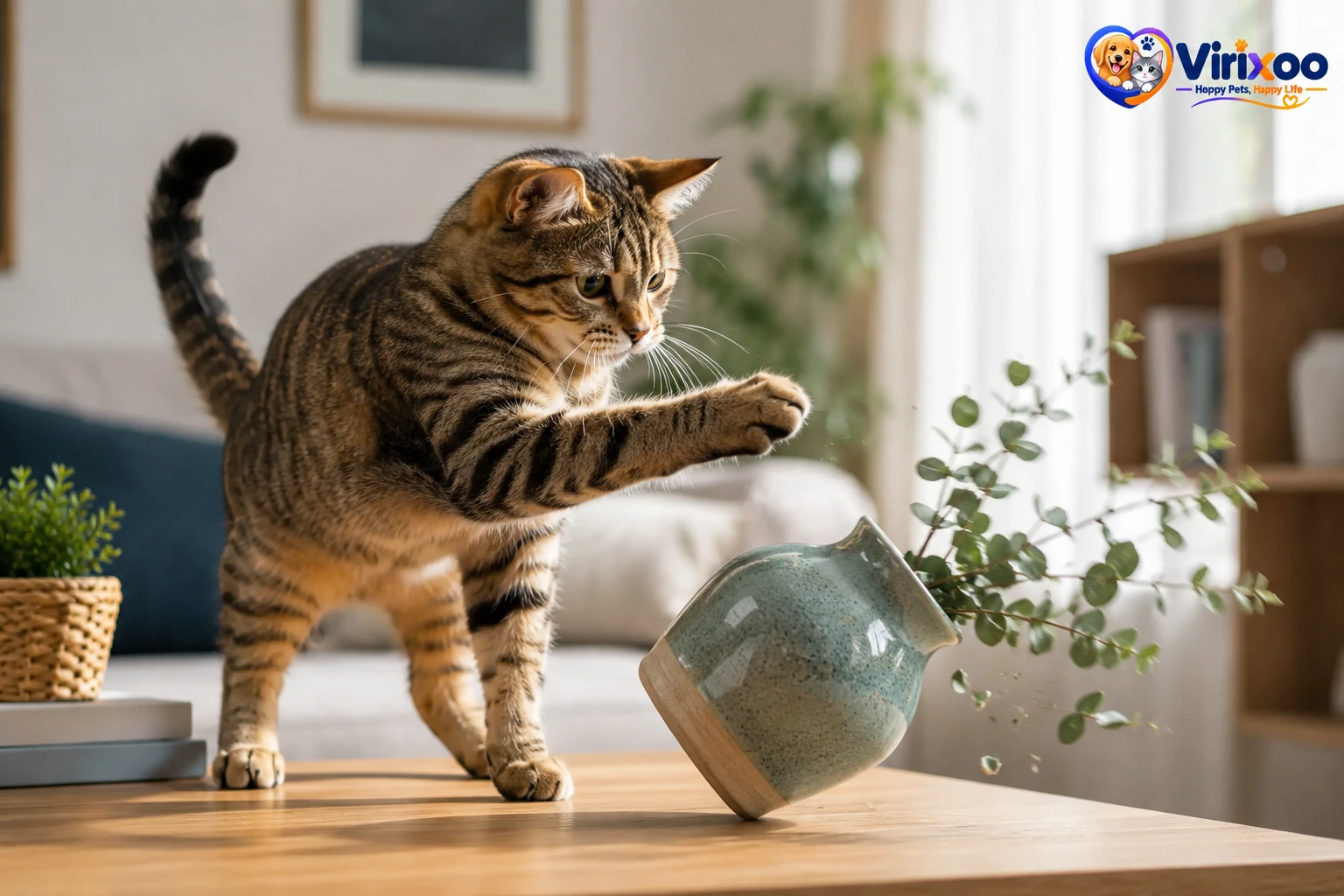
A cat that taps a pen, pushes a bottle cap, or sends a lightweight object off a shelf is often exploring cause and effect. Paws are important tools for investigation, and moving objects can be interesting because they roll, fall, make noise, or trigger a human reaction. The habit can be annoying, but it is usually more useful to manage the environment than to punish the cat.
Quick Answer
Cats knock objects over because of curiosity, play, hunting-like behavior, boredom, or because human reactions make the behavior rewarding. Remove fragile items, provide better play and puzzle opportunities, secure important objects, and avoid turning every incident into an exciting chase.
Why Cats Use Their Paws to Investigate
Cats often test unfamiliar objects with a paw before bringing their face closer. A light tap can reveal whether something moves, makes noise, or is safe to investigate. On a table, that same exploratory tap can become a dropped object.
Common Reasons for the Behavior
Curiosity
New objects are interesting. A cat may investigate a glass, pen, plant pot, or small decoration simply because it changed the environment.
Play
Small objects that roll or bounce can act like prey-like toys. A cap sliding across a smooth surface may be more exciting than a toy left untouched for weeks.
Attention
If knocking something over reliably makes a person jump up, talk, chase, or grab the cat, the event becomes socially rewarding. Even annoyed attention can maintain a behavior.
Boredom
A cat with few opportunities to climb, hunt, chase, scratch, and explore may invent its own entertainment. Household objects become the activity.
How to Reduce the Habit
- Move fragile objects. Prevention is the fastest way to protect valuable items.
- Use stable storage. Closed shelves, heavier bases, and secured decorations reduce opportunity.
- Add short play sessions. Interactive play gives your cat a more appropriate outlet for stalking and batting.
- Rotate toys. A small rotation can make old toys feel new again.
- Use food puzzles when appropriate. Safe puzzle feeding can provide an independent problem-solving activity.
- Reward calm behavior. Give attention when your cat is settled, not only after something crashes.
What Not to Do
- Do not spray water at your cat.
- Do not yell or hit.
- Do not leave dangerous glass, medication, chemicals, or small swallowable objects within reach.
- Do not rely on punishment instead of changing the environment.
Make Tables Less Interesting
Do not leave rolling objects near edges. Keep food smells off counters, store small items, and provide an approved elevated perch nearby. Cats often want height as much as the object itself.
Give Your Cat Better Things to Bat
Use safe lightweight toys that are large enough not to be swallowed. Wand play, track toys, and supervised rolling toys can satisfy the same pawing behavior without putting household objects at risk.
Frequently Asked Questions
Is my cat knocking things over on purpose?
The cat is intentionally moving the object, but that does not mean it is trying to annoy you. The behavior is more likely driven by curiosity, play, or reinforcement from what happens next.
Why does my cat look at me before pushing something?
Your reaction may have become part of the event. If previous incidents produced immediate attention, the cat may have learned the sequence.
Will more toys stop the behavior?
Not automatically. Quality, variety, placement, and interactive play matter more than simply owning many toys.
When to Investigate Further
If the behavior becomes part of a sudden major increase in activity, restlessness, vocalization, appetite, or other unusual changes, discuss the overall pattern with a veterinarian. The object-pushing itself is usually behavioral, but a sudden personality change deserves context.
Find the Trigger Before You Try to Stop It
The fastest way to reduce object-pushing is to identify when and where it happens. Some cats target items only when they are bored in the evening. Others do it near meal times, when a person is working at a desk, or when small objects are lined up near an edge. The pattern tells you whether the main reward is play, movement, access to a person, or the object itself.
For several days, note the time, room, object, and what happens immediately after the push. If you jump up every time, the human reaction may be part of the reward. If the cat continues batting the object after it falls, the movement itself may be more important. If the behavior occurs only on your desk while you are typing, attention and proximity may be contributing.
Use Environment Design Instead of Constant Correction
A cat cannot repeatedly knock over an unsafe item that is stored out of reach. That sounds obvious, but environmental management is often more reliable than trying to interrupt every attempt. Move breakable decorations away from ledges, secure containers, close medication drawers, and keep strings, batteries, sharp objects, and small swallowable items inaccessible.
| Problem Area | Better Setup |
|---|---|
| Desk with pens and small objects | Use drawers or containers with lids and add a nearby perch. |
| Kitchen counter | Remove food residue and keep fragile containers away from edges. |
| Nightstand | Store medication, glasses, and small electronics safely. |
| Display shelf | Move fragile items or use secure closed storage. |
Give Pawing Behavior an Appropriate Outlet
Instead of expecting your cat to stop using its paws to investigate, provide safer objects that move in interesting ways. Short wand-toy sessions, track toys, sturdy balls, and puzzle feeders can create the same opportunity to watch, touch, and manipulate something. Rotate a few options instead of leaving every toy available all the time.
Some cats that knock objects down also enjoy watching screens, investigating boxes, or carrying toys. Those patterns are part of the same broader need for stimulation. You can compare related behaviors in why cats love boxes and why cats bring toys to people.
How to Respond in the Moment
If the object is safe, keep your reaction calm. Do not chase the cat, shout, or turn the event into an exciting interaction. Pick up the item when convenient, then offer appropriate play at a different time. If the object is dangerous, intervene immediately for safety, but still avoid punishment.
Rewarding calm behavior can be more useful than reacting only after trouble starts. Give attention when the cat sits nearby without touching objects, uses an approved perch, or plays with an appropriate toy. This makes desirable behavior more predictable and rewarding.
When a Sudden Increase Deserves More Attention
Object-pushing is usually behavioral, but a sudden major increase in activity, restlessness, appetite, thirst, vocalization, or inability to settle should be considered as a whole. If your cat also seems unusually hungry, review why a cat may seem hungry all the time. If behavior has changed abruptly with other physical signs, discuss the pattern with a veterinarian rather than assuming the cat has simply become mischievous.
Related Virixoo Guides
Read why cats love boxes. Read why cats bring toys to people. Read why cats stare at their owners. Read why cats follow people around the home.
Final Thoughts
Knocking things over is usually a mix of curiosity and opportunity. Protect fragile items, make appropriate play more rewarding, reduce accidental attention rewards, and give your cat safe ways to explore. Environmental management works better than trying to convince a curious cat that gravity is off limits.