
A cat staring at you may be waiting for food, watching movement, asking for attention, tracking a routine, or simply observing from a comfortable place. The eyes alone do not tell the full story. Ears, tail, posture, distance, and what happened immediately before the stare are much more useful.
Quick Answer
Relaxed staring with a soft body, neutral ears, and occasional slow blinking is usually very different from a tense fixed stare with flattened ears, tail lashing, or a crouched posture. Consider the whole context before deciding what the behavior means.
Common Reasons Cats Watch People
You Predict Something Important
If you usually feed breakfast, open a favorite door, or start play at a certain time, your cat may watch closely when those events are expected.
Curiosity
Human movement changes the environment. Opening cabinets, carrying bags, using a laptop, or preparing food can all be worth monitoring.
Attention
Some cats learn that eye contact leads to talking, petting, play, or treats. Staring can become a quiet request.
Social Observation
Cats often spend time simply being near household members. Watching you from a chair may be part of relaxed social contact.
What Does a Slow Blink Mean?
A slow blink is commonly seen during calm interactions. You can respond with a relaxed blink of your own. Do not force eye contact with a fearful cat or move closer when the cat is trying to create distance.
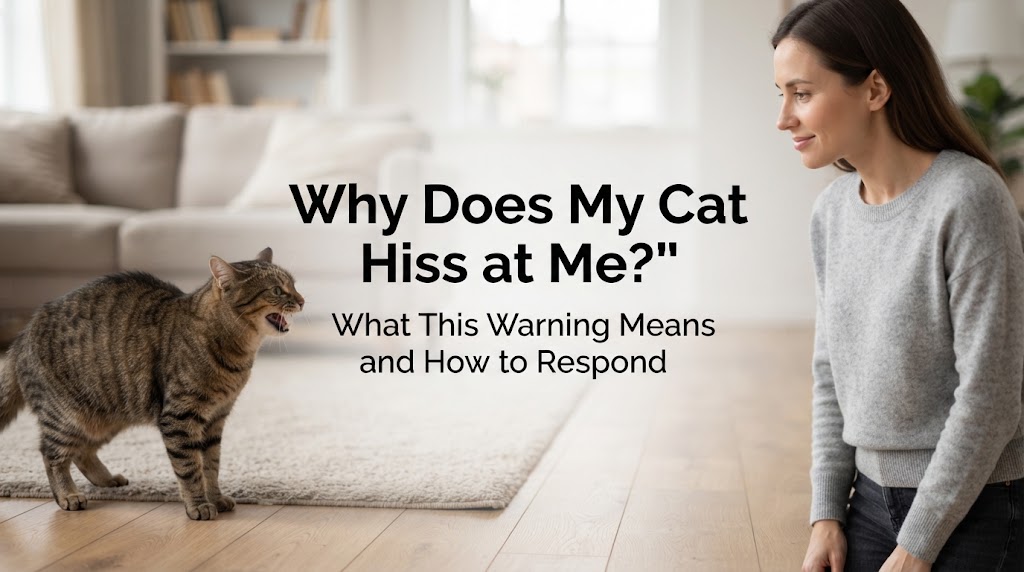
When a Stare Looks Tense
| Relaxed Signs | Tense Signs |
|---|---|
| Soft posture | Body frozen or crouched |
| Neutral ears | Ears flattened or sharply rotated |
| Slow blinking | Very fixed stare with little movement |
| Loose tail | Tail lashing or thumping |
| Can look away | Cannot disengage from trigger |
Staring Between Cats
In multi-cat homes, prolonged staring can sometimes be part of social pressure. One cat may block a hallway, litter box, or food area without an obvious fight. If another cat begins avoiding resources, spread them through the home and reduce bottlenecks.
Frequently Asked Questions
Why does my cat stare at me while I sleep?
Your cat may be awake while you are resting, waiting for a routine event, or simply sitting nearby. If the behavior is calm, it usually does not need interpretation as a problem.
Why does my cat stare and then meow?
The combination often functions as a request. Check the context: food schedule, closed doors, play, litter needs, or attention.
Should I stare back?
A prolonged hard stare can feel confrontational in some contexts. Use soft eyes and brief relaxed contact instead.
When to Investigate a Change
If staring becomes part of disorientation, unusual vocalization, bumping into objects, vision concerns, sudden aggression, or another major behavior change, contact a veterinarian.
Read the Sequence, Not Just the Eyes
A stare becomes easier to interpret when you look at what happened before and what happens next. If your cat watches you at the same time every morning and then walks toward the food area, the stare probably belongs to a learned routine. If the cat watches you while relaxed on a chair and then slow-blinks or settles to sleep, social observation is more likely. If the body is tense and the cat cannot look away, the situation deserves more distance.
Body Language Clues That Change the Meaning
Eyes are only one part of feline communication. Combine them with ears, whiskers, tail, posture, movement, and distance.
- Soft body and neutral ears: usually compatible with calm interest.
- Slow blinking: commonly appears during relaxed interactions.
- Tail flicking with a tense body: may signal rising arousal.
- Flattened ears and crouching: can indicate fear or defensive tension.
- Fixed attention on another cat: may be part of social pressure, especially near a doorway or resource.
Staring Around Food and Daily Routines
Cats are excellent at learning predictable human behavior. If you usually open a can, refill a bowl, or offer a treat after a certain movement, your cat may watch closely for the first sign that the sequence has started. Avoid assuming every stare means hunger. Check the actual feeding plan and body condition rather than responding automatically with food.
If your cat seems hungry at many times of day, compare the behavior with why cats may seem constantly hungry. If staring is followed by meowing mainly after bedtime, nighttime cat meowing may provide a better framework.
When Staring Happens Between Cats
Two cats do not need to fight loudly for tension to exist. One cat can control access simply by sitting in a narrow hallway and staring. Watch whether the other cat hesitates before approaching food, water, a litter box, or a resting area. In multi-cat homes, spreading important resources through different locations can reduce this kind of pressure.
If a new cat has recently joined the home, do not force face-to-face interaction. A gradual introduction is safer; see how to introduce two cats step by step.
A Three-Question Check for a New Staring Habit
- Is the behavior new? A longstanding relaxed habit is different from a sudden change.
- Can the cat disengage? A relaxed cat should be able to look away, groom, eat, or move normally.
- Are there other changes? Appetite, vision, mobility, vocalization, sleep, litter habits, and social behavior provide important context.
New staring combined with disorientation, bumping into objects, unusual pupil appearance, sudden aggression, or other neurological or visual concerns should be discussed with a veterinarian. The goal is not to diagnose from eye contact, but to notice when a familiar behavior becomes part of a larger change.
Common Interpretation Mistakes
Avoid treating every fixed look as a demand, threat, or sign of affection. Cats often watch movement because it is informative. Likewise, pupil size changes with light as well as arousal, so it should not be interpreted in isolation. The best reading combines posture, environment, and what the cat does next. If you are unsure, give the cat space and allow it to choose whether to approach.
For everyday behavior questions, consistency matters more than dramatic reactions. Respond to genuine needs, keep routines predictable, and reward calm communication. If a behavior changes suddenly, use that change as a reason to observe the whole cat rather than assigning a personality label.
Related Virixoo Guides
Read why cats follow their owners. Read why cats meow at night. Read how to introduce two cats safely. Read why cats choose to sleep on people.
Final Thoughts
Staring is not one message. Read the entire cat, the environment, and the routine. In most homes it is simply attention, curiosity, or social observation. Body language tells you whether the moment is relaxed or tense.