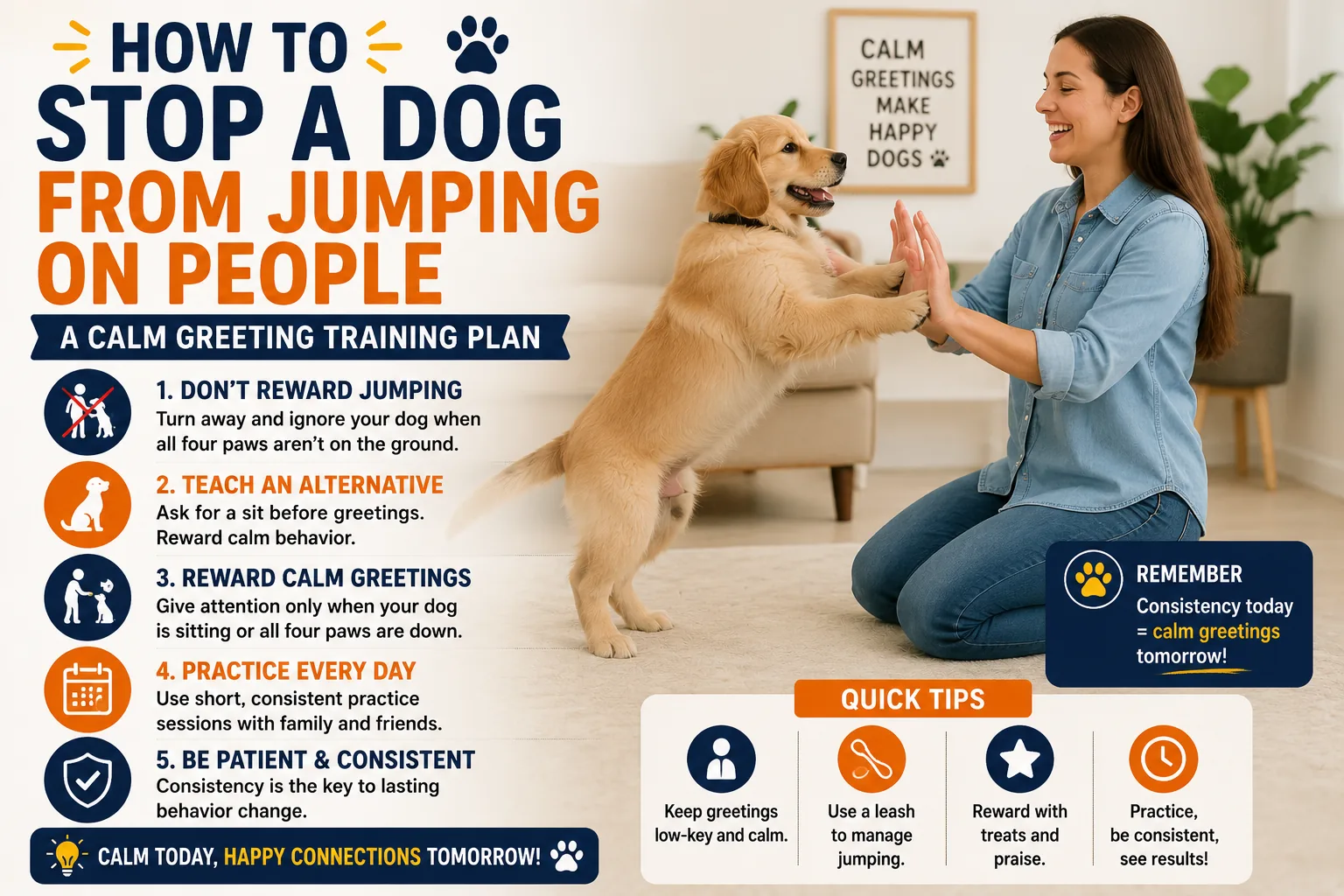
Jumping often persists because it reliably produces attention or access to people. A clear greeting routine can replace it with behavior that is easier for both dog and visitor. This guide focuses on practical, low-stress steps owners can use while recognizing situations that deserve veterinary or qualified behavior support.
Quick Answer
Start with management that prevents the problem from being repeatedly rehearsed, then teach one simple alternative at a difficulty the dog can handle. Reward successful behavior promptly. Avoid punishment, flooding, painful equipment, or forcing a frightened dog through the situation. Sudden behavior changes, pain, severe distress, breathing difficulty, collapse, or injury require veterinary attention rather than more training.
Prevent repeated jumping during training
Prevent repeated jumping during training is most effective when it is introduced in small, repeatable steps. Watch the dog's body language and ability to respond. A dog that can take food, explore, disengage and recover is generally in a better learning state than a dog that is frozen, frantic or trying to escape.
Reward four paws on the floor
Set up the environment before asking for difficult behavior. Reduce unnecessary distractions, keep sessions short, and decide exactly what behavior will earn reinforcement. This makes progress measurable and reduces accidental reinforcement of the old pattern.
Pause greetings when jumping starts
Increase only one part of the challenge at a time. More distance, longer duration and stronger distractions all make a task harder. If performance suddenly falls apart, return to an easier version instead of repeating the cue or adding pressure.
Practice with controlled helpers
Consistency across family members matters. A behavior that sometimes succeeds and sometimes does not can become especially persistent. Agree on the same cues, management rules and reward strategy so the dog receives clear information.
Make front-door sessions easier
Record what happens before, during and after difficult moments. A short log can reveal triggers, times of day, fatigue, environmental factors or health changes that are easy to miss. Video can also help a veterinarian or behavior professional when it can be recorded safely.
Keep household rules consistent
Safety comes before training speed. Use gates, leashes, distance or separate rooms when necessary. Management is not failure; it prevents unwanted practice and protects the dog and people while new skills are developing.
Separate excitement from fear or reactivity
Progress is rarely perfectly linear. Easier days and harder days are normal. Judge the plan by trends over several sessions and by the dog's emotional comfort, not by whether every repetition is perfect.
A Practical Training Framework
| What You See | Best Next Step |
|---|---|
| Relaxed and responsive | Repeat, reward, then increase difficulty slightly |
| Alert but able to recover | Keep the same level until it becomes easy |
| Unable to respond or take food | Reduce distraction, duration or distance |
| Panic, aggression, pain or escape behavior | Prioritize safety and seek professional guidance |
Common Mistakes to Avoid
- Increasing difficulty before the foundation is reliable.
- Repeating cues until they become background noise.
- Using punishment for fear, confusion or warning behavior.
- Training only when the real-life problem is already at maximum intensity.
- Ignoring sleep, pain, illness, environment and normal canine needs.
- Expecting one tool or one session to replace consistent practice.
Related Virixoo Guides
Continue with this closely related Virixoo guide. Another useful next step is this supporting guide. These links are selected to keep the reader within the same practical problem-solving topic cluster.
When to Involve a Veterinarian or Behavior Professional
Training should not be used to explain away a sudden change in behavior. Pain, neurologic disease, sensory changes, gastrointestinal or urinary discomfort, medication effects and other medical problems can alter behavior. Seek veterinary advice for abrupt changes, signs of pain, appetite or weight changes, unusual thirst or urination, weakness, collapse, breathing problems, or behavior that creates an immediate safety risk. For significant fear, aggression or repeated failure despite careful management, a qualified reward-based behavior professional can help build an individualized plan.
FAQ
How quickly should I expect improvement?
There is no universal timeline. Learning history, age, environment, motivation, health and the intensity of the trigger all affect progress. Small reliable gains are more useful than rushing to a difficult test.
Should I stop using treats?
Food is one useful reinforcer, not a bribe. As skills strengthen, real-life rewards such as movement, sniffing, play and access can become part of the reinforcement plan. Difficult situations may still justify high-value food.
What if the behavior suddenly gets worse?
Reduce difficulty and look for changes in health, routine or environment. Sudden or unexplained deterioration deserves veterinary discussion, especially when pain or other physical signs are present.
Bottom line: Prevent repeated failure, teach an achievable alternative, reinforce it well, and increase difficulty gradually. Good dog training protects both safety and emotional welfare.