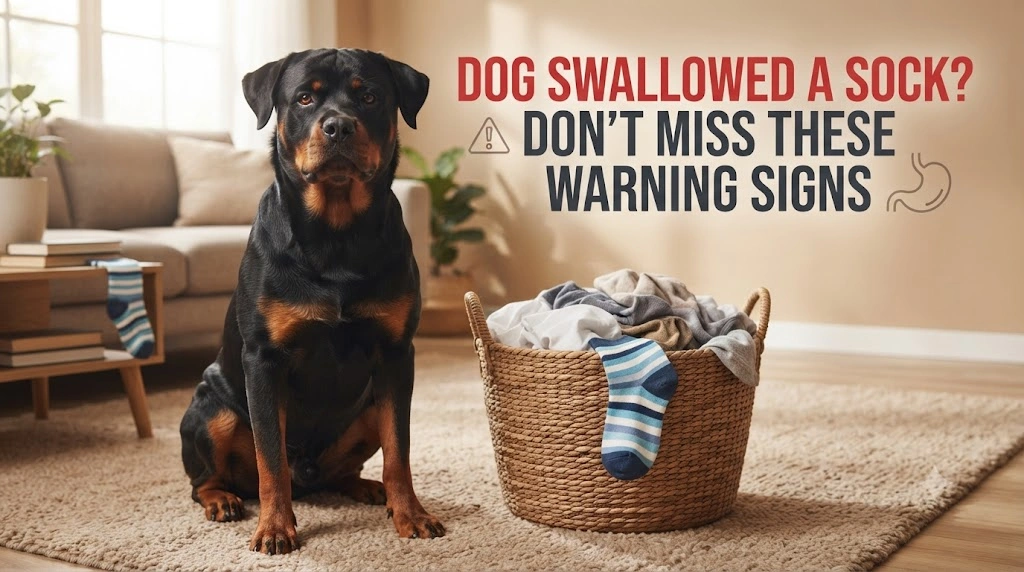
A dog that swallows a sock can appear completely normal at first and still develop a gastrointestinal obstruction later. Fabric may remain in the stomach, pass through the intestines, or become lodged. The safest response is to contact a veterinarian promptly rather than waiting for symptoms to prove that the sock is stuck.
Quick Answer
If you know or strongly suspect that your dog swallowed a sock, call your veterinarian or an emergency clinic for advice now. Do not induce vomiting unless a veterinary professional specifically instructs you to do so. Seek urgent care for repeated vomiting, inability to keep water down, abdominal pain, lethargy, loss of appetite, bloating, repeated unproductive retching, weakness, or collapse.
Why a Dog Can Look Fine at First
An obstruction does not always cause immediate symptoms. A sock may sit in the stomach before moving into the intestines. Early signs can be subtle, and the dog may continue eating or playing for a period of time. This is why normal behavior immediately after swallowing the object does not guarantee safety.
Size and Dog Size Matter, But They Do Not Predict the Outcome
A sock that might pass through one large dog could obstruct a smaller dog. Even in a large dog, fabric can bunch, twist, or lodge. It is not possible to determine from appearance alone whether the object will pass safely.
Why Timing Matters
Veterinary options may be different soon after ingestion than they are after an object has moved farther through the gastrointestinal tract. Calling early gives the veterinarian more information and more potential options.
Do Not Induce Vomiting on Your Own
Home vomiting methods can cause aspiration, burns, or other complications and may be inappropriate for the object or the dog's condition. Only induce vomiting when a veterinarian or poison professional gives a specific instruction for your dog.
Obstruction Signs to Watch For
| Sign | Why It Matters |
|---|---|
| Repeated vomiting | Common with gastrointestinal obstruction |
| Loss of appetite | May indicate nausea or pain |
| Abdominal pain | Can develop as obstruction progresses |
| Lethargy | Suggests systemic illness or dehydration |
| Little or no stool | May occur with obstruction, but normal stool does not rule it out early |
| Repeated retching | Can signal a serious gastrointestinal emergency |
Normal Stool Does Not Prove the Sock Passed
Material already beyond the obstruction can still be passed, so a dog may produce stool even after a foreign object becomes lodged. Do not use one normal bowel movement as proof that the problem is over.
Should You Search the Stool?
Your veterinarian may advise monitoring for passage in some cases, but this should follow professional assessment. If you are asked to monitor, use gloves and follow hygiene precautions. Do not delay care if symptoms develop just because the sock has not yet appeared.
What the Veterinarian May Do
The veterinarian may recommend examination, imaging, endoscopy, or surgery depending on timing, object size, location, and symptoms. Fabric is not always easy to see directly on standard X-rays, so additional imaging or repeat evaluation may be needed.
What Not to Do
- Do not induce vomiting without veterinary instruction.
- Do not give oil, bread, bulky food, or laxatives to push the sock through.
- Do not pull fabric from the rectum if it appears attached or resists.
- Do not wait for severe symptoms before calling.
Prevention After the Crisis
Dogs that repeatedly swallow socks may have a strong scavenging habit, play pattern, or compulsive behavior. Use closed hampers, secure laundry areas, and active supervision. If the behavior is frequent, discuss it with a veterinarian or qualified behavior professional.
When to Seek Emergency Care
Seek urgent care for repeated vomiting, inability to keep water down, severe abdominal pain, progressive bloating, repeated unproductive retching, collapse, severe weakness, or marked lethargy.
Bottom Line
A dog can look normal after swallowing a sock and still be at risk of obstruction. Contact a veterinarian promptly, avoid home vomiting or “push it through” remedies, and treat vomiting, pain, lethargy, or inability to keep water down as urgent warning signs.
Why Fabric Foreign Bodies Are Unpredictable
Soft objects can fold, bunch, or stretch, which makes their behavior in the gastrointestinal tract difficult to predict. A sock that looks small compared with the dog can still lodge in a narrow area. This uncertainty is why early veterinary advice is more reliable than estimating risk from the object's size by eye.
If you know the approximate time of ingestion and the type of sock, tell the veterinarian. A photo of an identical sock can also help describe size and material.
Why Waiting for Vomiting Can Be Risky
Vomiting is a common obstruction sign, but it may not appear immediately. A dog can seem normal while a foreign body remains in the stomach or while a partial obstruction develops. Early veterinary advice is therefore safer than using vomiting as the threshold for action.
Partial vs. Complete Obstruction
A partial obstruction may allow some food, liquid, gas, or stool to pass, creating intermittent symptoms. A complete obstruction tends to produce more severe signs. Owners cannot reliably distinguish these at home, and both can require treatment.
Why Fabric Can Be Hard to Detect
Some fabrics are not clearly visible on standard X-rays. Veterinarians may look for indirect signs such as abnormal gas patterns or may use ultrasound or repeat imaging. A normal first image does not always end the evaluation if clinical suspicion remains high.
Do Not Pull Fabric From the Mouth or Rectum
If string, fabric, or another object is protruding and resists gentle movement, do not pull. It may be anchored internally, and traction can damage the gastrointestinal tract. Seek veterinary help.
What Information Helps the Vet
Report the approximate time of ingestion, the dog's size, whether the sock was whole or torn, whether other objects may have been swallowed, and any symptoms. Bring a matching sock or photo if available.
Dogs That Repeatedly Eat Fabric
Repeated ingestion can be linked to scavenging, play, boredom, anxiety, or pica. Management should include secure laundry storage and supervision. A veterinarian may also consider medical contributors if the behavior is persistent.
After Treatment
Follow discharge instructions carefully. If the dog was managed without surgery, watch for vomiting, appetite loss, pain, or lethargy. If surgery was required, monitor the incision and activity according to the veterinary plan.
Why Eating Normally Does Not Rule Out a Foreign Body
Some dogs continue to eat in the early stages after swallowing a sock, particularly if the object remains in the stomach or only partially blocks the intestine. Appetite alone cannot prove that the sock is moving safely. A dog can look normal for hours and then develop vomiting or pain later.
What If You Are Not Completely Sure the Sock Was Swallowed?
If a sock is missing and the dog has a history of swallowing fabric, treat the possibility seriously. Search the immediate area quickly, but do not spend hours looking while delaying veterinary advice. Tell the clinic that ingestion is suspected rather than confirmed and explain why.
Why “Bulking Up” the Meal Is Not a Safe Strategy
Feeding bread, pumpkin, fiber, or a large meal in an attempt to wrap around the sock can make management more complicated and does not guarantee passage. The appropriate plan depends on timing and location, so follow veterinary instructions instead of trying to push the object through.
How to Prevent Another Sock Ingestion
Use laundry hampers with secure lids, keep bedroom and bathroom floors clear, and close access to rooms where clothing is commonly left out. Dogs that steal fabric for attention should not be chased around the house because the chase can reinforce the game. Trade for a safe item and improve management so the dog cannot rehearse the behavior.
If fabric swallowing happens repeatedly, discuss pica, anxiety, gastrointestinal issues, and behavior patterns with your veterinarian rather than treating each incident as an isolated accident.
How to Prevent Another Sock Ingestion
Use laundry hampers with secure lids, keep bedroom and bathroom floors clear, and close access to rooms where clothing is commonly left out. Dogs that steal fabric for attention should not be chased around the house because the chase can reinforce the game. Trade for a safe item and improve management so the dog cannot rehearse the behavior.
If fabric swallowing happens repeatedly, discuss pica, anxiety, gastrointestinal issues, and behavior patterns with your veterinarian rather than treating each incident as an isolated accident. Prevention is especially important because every new ingestion carries another obstruction risk.
What to Watch for After the Vet Advises Monitoring
If your veterinarian decides home monitoring is appropriate, follow those instructions exactly. Watch appetite, vomiting, abdominal comfort, energy, and stool. Contact the clinic immediately if symptoms appear or worsen. Do not assume that one normal meal or bowel movement proves the sock has passed safely.