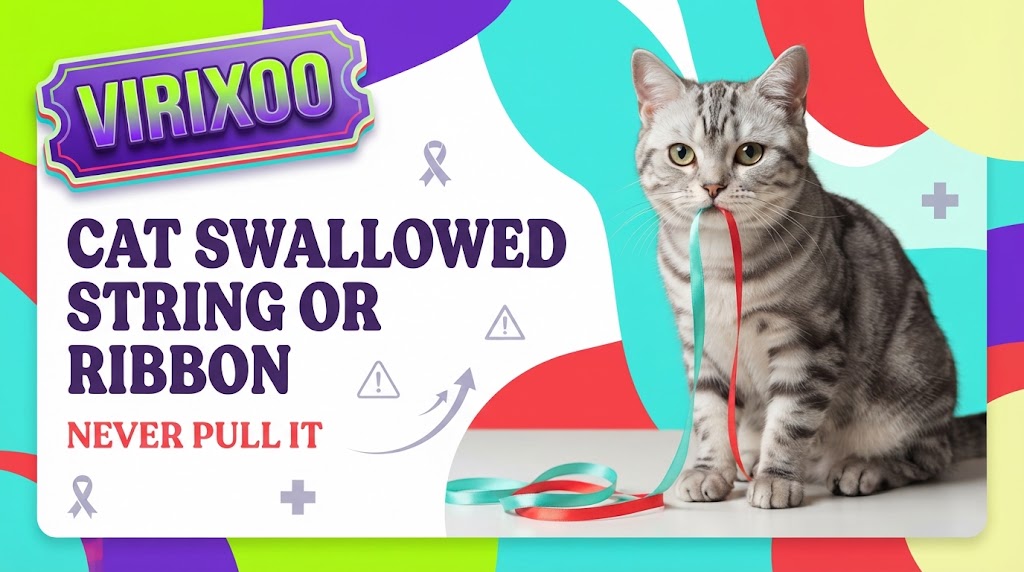
If a cat swallows string, ribbon, thread, yarn, dental floss, or tinsel, treat it as a potentially serious foreign-body problem. Long flexible objects can behave differently from ordinary swallowed items. One end may become anchored under the tongue or in the stomach while the rest moves through the intestines, creating tension that can bunch or damage the bowel.
Quick Answer
Call a veterinarian promptly if you know or strongly suspect that your cat swallowed string or ribbon. Never pull visible string from the mouth or anus. Do not induce vomiting unless a veterinarian specifically instructs you to do so. Seek urgent care for repeated vomiting, abdominal pain, lethargy, food refusal, hiding, dehydration, or a string visible under the tongue.
Why String Is Different From Many Other Objects
A small smooth object may sometimes pass through the gastrointestinal tract, but a long string-like object can become anchored at one point. As the intestines continue normal movement, they may gather along the string. This can injure the intestinal wall and in severe cases contribute to perforation and abdominal infection.
Common Linear Foreign Bodies
- Sewing thread
- Ribbon
- Yarn
- Dental floss
- Tinsel
- Fishing line
- Elastic string
- String from toys or packaging
Why Cats Are Especially at Risk
Cats are attracted to narrow moving objects because they resemble prey. Kittens and playful adults may chew or swallow material during play before an owner realizes what happened. Sewing needles attached to thread are an additional danger because they can puncture the mouth, esophagus, stomach, or intestine.
What If String Is Hanging From the Mouth?
Do not pull it. Material visible in the mouth may be wrapped around the tongue or anchored farther down. Pulling can place dangerous tension on internal tissues. Keep the cat from chewing the exposed string if possible and transport the cat for veterinary assessment.
What If String Is Hanging From the Anus?
Again, do not pull. The visible end may still be attached inside. Cut nothing unless a veterinarian directs you. Prevent the cat from chewing or dragging the material and seek veterinary care.
Early Signs Can Be Subtle
A cat may initially look normal. As irritation or obstruction develops, signs can include repeated vomiting, reduced appetite, hiding, lethargy, drooling, abdominal discomfort, diarrhea, constipation, or reluctance to be handled around the belly.
Red Flags
| Finding | Why It Matters |
|---|---|
| Repeated vomiting | Possible obstruction or intestinal irritation |
| String under the tongue | Possible anchored linear foreign body |
| Abdominal pain | May indicate significant intestinal injury |
| Food refusal | Common with gastrointestinal obstruction |
| Weakness or collapse | Emergency |
Why Normal Stool Does Not Guarantee Safety
A cat can still pass stool that was already beyond the affected area. One normal bowel movement after ingestion does not prove that the string has passed safely.
What the Veterinarian May Do
The veterinarian may examine under the tongue, palpate the abdomen, and use X-rays or ultrasound. String itself may not always be obvious on an X-ray, so veterinarians often look for changes in the shape or gas pattern of the intestines. Endoscopy or surgery may be needed depending on location and severity.
What Not to Do
- Do not pull string from the mouth or anus.
- Do not induce vomiting without veterinary instruction.
- Do not feed bulky food to “push it through.”
- Do not give oil, laxatives, or home remedies.
- Do not wait for severe symptoms if ingestion is known.
Prevention
Store sewing supplies, ribbon, tinsel, dental floss, yarn, and string toys where the cat cannot reach them. Supervise interactive toys and put them away after play. Inspect toys regularly for loose threads or frayed pieces.
Bottom Line
String and ribbon can become dangerous linear foreign bodies in cats. If ingestion is known or strongly suspected, contact a veterinarian promptly and never pull visible material from either end of the gastrointestinal tract.
What If You Are Not Sure the String Was Swallowed?
If string is missing and your cat was playing with it, treat the possibility seriously. Search the immediate area quickly but do not spend hours delaying veterinary advice. Tell the clinic that ingestion is suspected rather than confirmed and describe the type and approximate length of material.
Why Thread Under the Tongue Matters
Veterinarians may carefully inspect beneath the tongue because thread can loop around the base. Owners should not force the mouth open or try to cut deeply placed material themselves.
After Treatment
Follow feeding, medication, and activity instructions. Contact the clinic for renewed vomiting, appetite loss, abdominal pain, lethargy, or abnormal stool. If surgery was required, monitor the incision and restrict activity as directed.
What to Record Before You Call
For cat swallowed string or ribbon, write down the exact time the problem or exposure began, what you saw, and whether the cat is getting better, worse, or staying the same. Record appetite, drinking, urination, stool, vomiting, breathing, movement, awareness, and any unusual behavior. For poisoning or foreign-body concerns, keep the product package, plant photo, object description, or medication label available.
Do not delay urgent care to collect perfect information. When a cat is weak, collapsing, struggling to breathe, seizing, repeatedly vomiting, unable to urinate, or rapidly deteriorating, transport takes priority over documentation.
How to Decide Whether Monitoring Is Still Safe
Monitoring is only reasonable when the cat is comfortable, the exposure or behavior has been professionally judged low-risk, and no red flags are present. A cat that becomes quieter may not simply be resting; it may be becoming weaker. Look at the whole cat rather than one visible sign.
If new pain, breathing changes, neurologic signs, food refusal, repeated vomiting, or abnormal urination develops, contact the veterinarian again even if the original sign appears slightly improved.
Common Mistakes to Avoid
- Waiting for severe symptoms after a known high-risk exposure.
- Giving a home remedy before identifying the substance or object.
- Using medication prescribed for another pet.
- Forcing food, water, or handling when the cat is distressed.
- Assuming that normal walking or eating rules out a serious problem.
What Follow-Up Should Focus On
After treatment or professional advice, track whether the cat returns toward its normal baseline. Appetite, grooming, breathing, movement, litter-box habits, and interaction should all be considered. Follow recheck recommendations even when the visible problem seems better, because some toxicities and internal injuries can evolve after the first examination.
Why Early Advice Often Changes the Outcome
Many feline emergencies are easier to treat before severe symptoms develop. Early veterinary or poison-control guidance can determine whether decontamination, imaging, observation, or immediate treatment is appropriate. Waiting until the cat is obviously ill can remove safer or less invasive options.
When in doubt, describe the exact exposure or behavior, the timeline, and the cat’s current condition rather than trying to diagnose the problem yourself.
Why Symptoms Can Be Delayed
A linear foreign body may not cause dramatic signs immediately. A cat can continue eating, playing, or passing stool while the string remains in the stomach or begins moving into the intestine. As normal intestinal contractions continue, the bowel can gather around the anchored material and irritation can worsen over time. This is why “she seems fine right now” is not a reliable reason to wait after a known ingestion.
What If the Cat Vomits the String Back Up?
If string appears in vomit but part of it remains in the mouth or seems attached, do not pull. If the entire piece is clearly expelled and you are certain nothing remains, still contact the veterinarian if vomiting continues, appetite drops, or the cat seems painful. Thread attached to a needle or another object deserves immediate evaluation even if part of it comes back up.
Why Ultrasound May Be Helpful
String itself can be difficult to see directly on standard radiographs. Ultrasound may show characteristic intestinal bunching, abnormal movement, fluid, or other changes suggesting a linear foreign body. The veterinarian decides which imaging test is most useful based on the cat’s symptoms and examination.
How to Cat-Proof String Hazards
Keep sewing kits closed, dispose of dental floss in covered bins, avoid leaving ribbon on gift packages, and supervise toys with strings or feathers. Interactive wand toys should be stored after play rather than left on the floor. Holiday tinsel deserves special caution because it is shiny, light, and attractive to cats.
What Improvement Should Look Like
For cat swallowed string or ribbon, improvement means the cat is returning toward its normal baseline rather than showing only one isolated change. Appetite, grooming, movement, breathing, litter-box habits, awareness, and social behavior should all be considered. If the original sign looks better but the cat becomes weaker, more withdrawn, painful, or unable to perform a normal function, the overall situation is not improving.
Follow any veterinary instructions exactly and complete recommended rechecks. Do not add supplements, human medication, or home remedies unless the veterinary team specifically approves them.