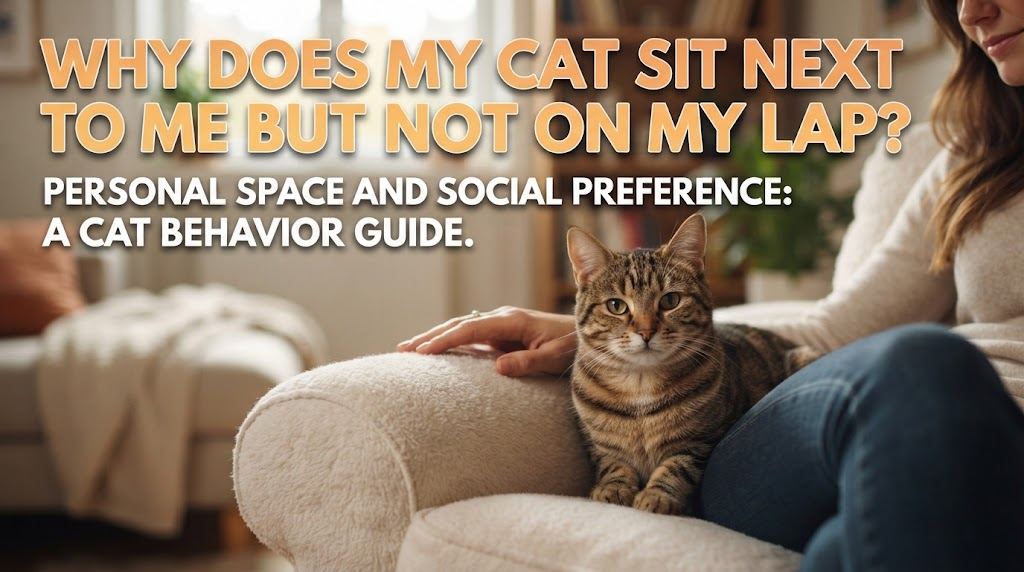
A cat that chooses the cushion beside you every evening is not necessarily avoiding affection. For many cats, sharing space is the preferred form of social contact.
Quick Answer
Your cat may sit next to you instead of on your lap because it likes your company but prefers more control over movement, temperature and physical contact. Cats differ widely in how much petting, holding and lap time they enjoy. Voluntarily choosing a place beside you is still a meaningful social choice.
Close Does Not Have to Mean Touching
Human affection often emphasizes hugging and sustained contact. Cats do not all use social space that way. One cat may sleep on a person's chest, while another regularly sits within arm's reach and leaves if picked up. Neither pattern automatically says how strongly the cat is bonded to the person.
Your Lap Moves
Legs shift, hands reach, people stand up unexpectedly, and a lap can become unstable. A sofa cushion or chair beside you may offer the same social proximity with a predictable surface and an easy exit. Some cats prioritize that control.
Temperature Can Change the Preference
A warm lap can be attractive in winter and uncomfortable in a hot room. If your cat becomes more lap-oriented in cool weather and more likely to sit beside you in summer, temperature may be part of the explanation.
Handling History Matters
Cats that were not accustomed to being held when young may still develop strong relationships with people while preferring less restraint. Individual genetics, early socialization and past experiences all influence comfort with touch. The goal is not to train every cat into becoming a lap cat.
Read the Difference Between Preference and Avoidance
| Relaxed beside-you behavior | Signs the cat wants more space |
|---|---|
| Loose body and neutral ears | Body becomes stiff when touched |
| Returns to sit near you voluntarily | Repeatedly moves farther away |
| May slow blink, purr or rub | Tail lashes, ears turn back or cat swats |
| Leaves calmly when finished | Looks trapped or struggles to escape |
How to Make Lap Contact More Likely Without Forcing It
If you want to invite the behavior, sit still, place a familiar soft blanket over your legs, keep interactions brief, and let the cat approach. Pet only where the cat normally enjoys touch. If it chooses the cushion beside you instead, allow that option to remain available.
Do not repeatedly pick the cat up and place it on your lap after it leaves. Forced contact can make the lap less attractive, not more.
A Sudden New Aversion to Contact Is Different
A cat that used to jump onto your lap but suddenly avoids being picked up or touched may be experiencing pain or another health problem. Watch for reduced jumping, stiffness, hiding, grooming changes or sensitivity over a specific body area and discuss persistent changes with a veterinarian.
Related Virixoo Guides
For cats that prefer full-body contact, see why cats sleep on people. If your cat follows you from room to room without necessarily wanting touch, read why cats follow their owners. If touch changes into a warning swat, see how to read swatting during interaction.
Bottom Line
A cat can seek companionship without wanting to sit on a lap. Respecting individual contact preferences usually creates better interactions than trying to force more closeness. If your cat repeatedly chooses to sit beside you, that choice itself is useful information about where it feels comfortable.