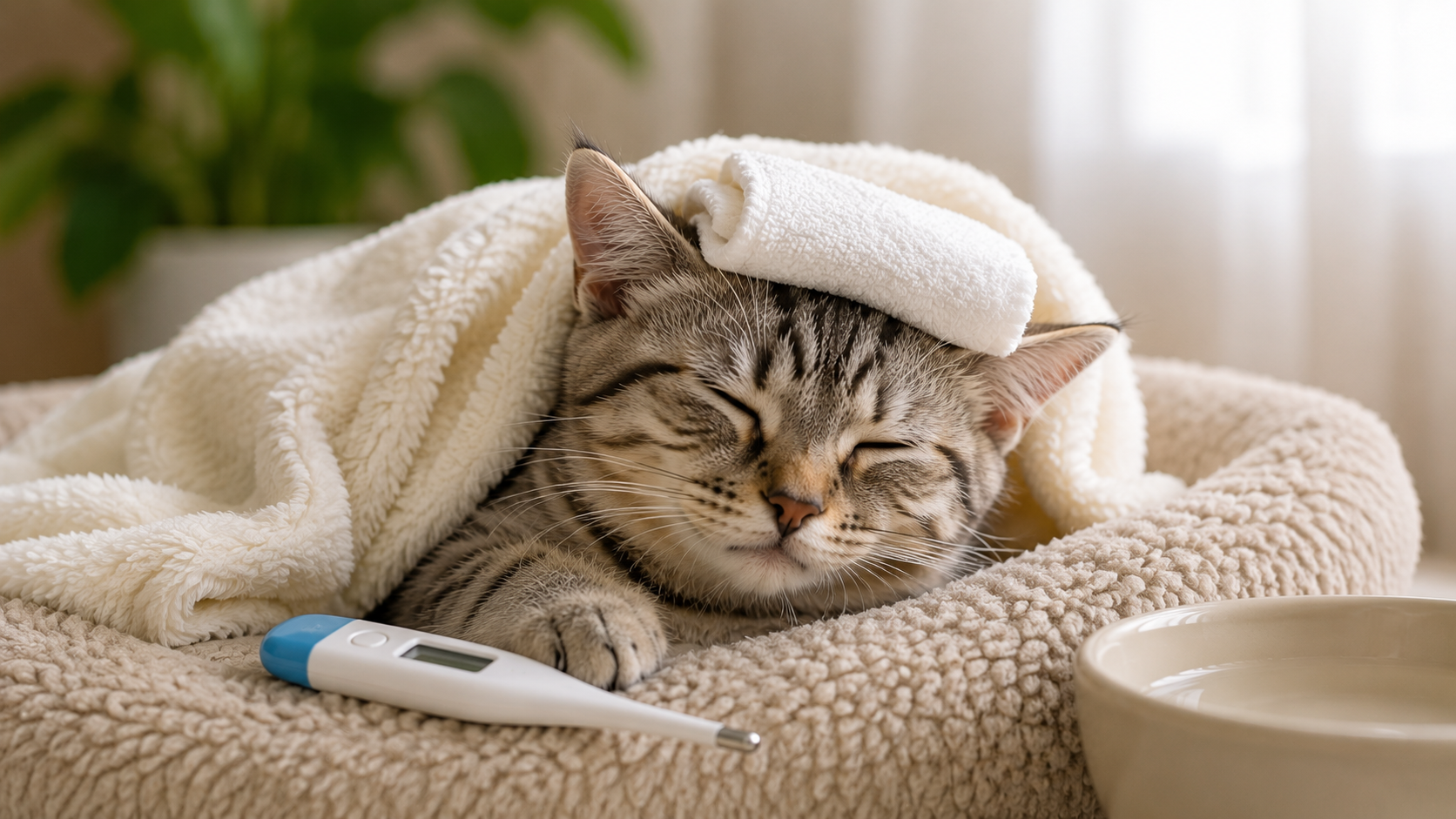

If your cat regularly curls up on your chest, legs, stomach, or beside your head, the simplest explanation is usually that you are warm, familiar, predictable, and comfortable. Cats choose sleeping locations carefully because sleep makes them less alert to the environment. A cat that chooses to sleep on a trusted person may be combining several motivations at once: warmth, scent, routine, social contact, and a secure resting surface.
Quick Answer
Sleeping on you is usually a normal behavior. Your body gives off heat, carries a familiar scent, and may provide a stable place where your cat feels safe. Some cats also learn that lying on a person leads to petting or attention. The behavior is most worth investigating when it appears suddenly together with restlessness, clinginess, pain, breathing changes, appetite changes, or other unusual signs.
Common Reasons Cats Sleep on Their Owners
Warmth
Cats often seek warm places. Your lap, chest, or legs can become an attractive resting spot, especially in cooler rooms. This does not mean every cat that sleeps on a person is cold; warmth is simply one of several possible rewards.
Familiar Scent
Your clothing and skin carry scents your cat encounters every day. Familiar scent can make a sleeping area feel predictable. A cat may prefer your blanket, pillow, or laundry for the same reason.
Social Attachment
Many cats form strong social relationships with people. Some show attachment by following, greeting, rubbing, or sleeping close by. Sleeping on you can be one part of a broader social pattern rather than a special signal with one fixed meaning.
Routine
If your cat joins you every evening while you watch television or every night after the lights go out, the behavior may be strongly tied to routine. Cats are often good at noticing repeated household patterns.
Comfort and Security
A calm person can be a stable resting place. Your cat may feel less exposed sleeping on you than sleeping in the middle of an open room.
Does Sleeping on You Mean Your Cat Loves You?
It can be consistent with a trusting relationship, but no single behavior proves one emotion. Look at the whole relationship: does your cat approach willingly, relax near you, play normally, eat well, and choose social contact without being forced? Those patterns together are more meaningful than one sleeping position.
Why Does My Cat Sleep on My Chest?
Your chest is warm and rises gently with breathing. Some cats seem to find the combination of warmth, movement, and proximity soothing. If the weight is uncomfortable, calmly move the cat to a nearby bed rather than pushing or startling it.
Why Does My Cat Sleep Near My Head?
The head and pillow area may be warm, less likely to move than legs, and strongly scented by the owner. Hair and bedding can also provide a soft resting surface.
When the Habit Becomes Inconvenient
- Place an attractive cat bed beside you instead of across the room.
- Warm the bed safely with room temperature placement rather than unsafe heating devices.
- Reward your cat for settling in the alternative location.
- Keep bedtime routines predictable.
- Avoid making removal from your body frightening or dramatic.
Sudden Clinginess Deserves Context
A cat that has always slept nearby is different from a previously independent cat that suddenly cannot settle unless touching you. Sudden changes can happen after stress, household changes, or changes in health. Watch appetite, mobility, litter box habits, grooming, vocalization, breathing, and overall energy.
Frequently Asked Questions
Why does my cat sleep on me but not my partner?
Your cat may prefer your body temperature, smell, sleeping position, routine, or the way you respond. Preference does not necessarily mean rejection of another person.
Should I let my cat sleep on me every night?
If both you and your cat are comfortable and the arrangement does not interfere with sleep or safety, there is usually no need to stop it. If your sleep is disrupted, teach an attractive nearby alternative.
Why does my cat knead before sleeping on me?
Kneading can be part of a settling routine. Provide a blanket if claws make the behavior uncomfortable, and keep nails appropriately maintained.
When to Contact a Veterinarian
Seek veterinary advice if a major change in sleeping behavior appears with weakness, pain, breathing difficulty, reduced appetite, weight loss, increased thirst, confusion, or other illness signs. Sleeping close to you by itself is usually not a medical concern, but a sudden behavior change can be useful information.
How to Tell Comfort From a New Need for Reassurance
The same sleeping position can mean different things depending on what else is happening. A cat that has always chosen your lap or chest, settles with loose muscles, grooms normally, eats well, and easily moves to another resting spot is probably using you as a familiar place to relax. A cat that suddenly follows you constantly, refuses to settle alone, vocalizes when you move, or seems unable to get comfortable deserves a closer look at the whole day.
Changes in the household can temporarily increase proximity-seeking. Visitors, moving furniture, a new pet, construction noise, travel, or a change in your work schedule can make a familiar person more attractive as a resting anchor. In that situation, keeping meals, play, litter care, and bedtime predictable can help without forcing the cat to sleep separately.
Build an Appealing Alternative Sleeping Spot
If you enjoy the closeness but need more space at night, make the alternative easier to choose rather than repeatedly removing the cat after it settles. Put a soft bed or folded blanket near your usual sleeping or sitting area. Cats often prefer a location that is warm, slightly elevated, protected on one or two sides, and close enough to monitor the room.
- Start nearby. Place the alternative bed next to you rather than across the room.
- Use familiar scent. A clean blanket that already smells like the home can make the spot more inviting.
- Reward voluntary use. Quiet praise, petting, or an appropriate treat can reinforce choosing the bed.
- Be consistent. If you sometimes allow chest sleeping and sometimes abruptly remove the cat, the rule may be difficult to learn.
- Protect your own sleep. Good cat care does not require accepting a routine that repeatedly wakes you.
What Sleeping Position Can and Cannot Tell You
Owners often search for a precise emotional meaning in where a cat sleeps. Position can offer clues, but it should not be treated like a code. A cat on your legs may simply prefer the stable surface. A cat beside your head may like the warmth and scent of the pillow. A cat that moves away during the night may be adjusting temperature or avoiding movement. None of these positions, by themselves, prove dominance, anxiety, illness, or a special preference.
More useful clues are whether your cat can relax independently, whether the behavior is longstanding, and whether other daily functions remain normal. If your cat also follows you from room to room, compare the pattern with the Virixoo guide on why cats follow their owners everywhere. If closeness mainly increases after dark, the guide on nighttime meowing may help you look for routine or environmental triggers.
A Simple One-Week Observation Plan
For seven days, note where your cat starts the night, whether it changes locations, what time it seeks contact, and whether the pattern changes after play or meals. Also note appetite, litter box habits, movement, grooming, and energy. This turns a vague feeling that the cat is "more clingy" into a pattern you can compare.
If everything else remains normal and the behavior is stable, there may be nothing to fix. If the sleeping change is sudden and accompanies reduced appetite, weakness, breathing changes, pain, confusion, or a major increase in vocalization, veterinary advice is more useful than trying to interpret the sleeping position alone.
Related Virixoo Guides
Read why cats sleep so much. Read why your cat follows you everywhere. Read why cats meow at night. Read why cats bring toys to their owners.
Final Thoughts
Most cats sleep on people because the arrangement combines warmth, familiarity, security, and social contact. You do not need to decode it as a single message. If your cat is relaxed and healthy, enjoy the habit or gently redirect it when necessary. If the pattern changes suddenly, look at the bigger picture rather than the sleeping position alone.