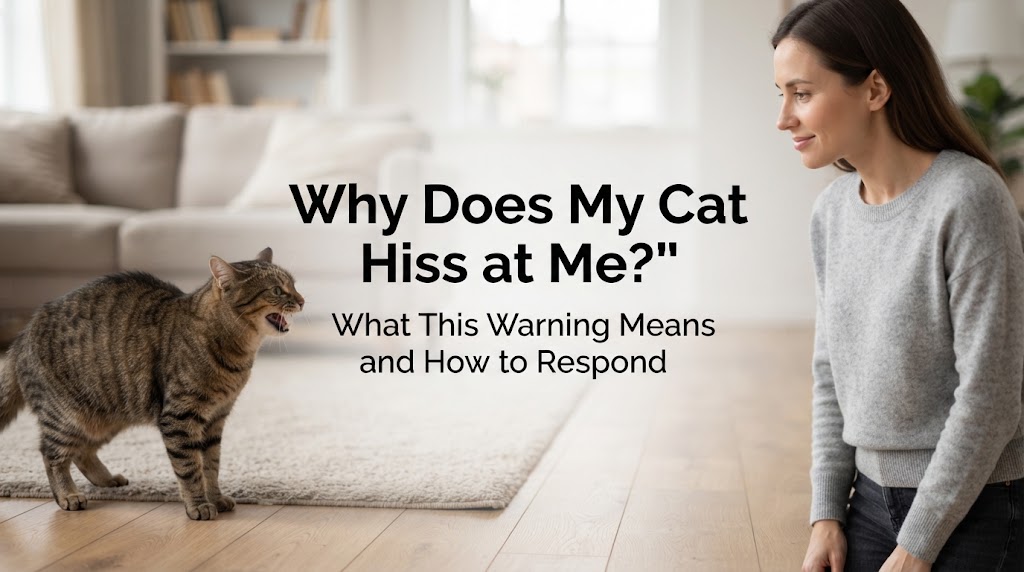
A hiss is one of the clearest distance-increasing signals a cat has. It usually means “I am uncomfortable—do not come closer,” not “I am being bad.” Cats may hiss when frightened, cornered, startled, overstimulated, in pain or guarding access to an important space. Listening to the warning can prevent escalation to swatting or biting and can help you identify what changed.
Quick Answer
Stop approaching when your cat hisses. Turn your body slightly away, avoid staring and give the cat a clear exit or hiding option. Think about what happened immediately before the hiss: touching a sore area, picking the cat up, a visitor, another animal, a loud event or restricted escape. A new hissing pattern—especially with pain, appetite changes, limping or withdrawal—deserves a veterinary check.
Common Reasons a Cat Hisses at a Person
Fear or surprise
A sudden reach, unfamiliar clothing, loud noise or unexpected approach can make a cat feel threatened. The hiss is often an attempt to stop the interaction before physical defense becomes necessary.
Pain or physical sensitivity
A cat that hisses when a particular body area is touched may be protecting a painful spot. Dental pain, arthritis, injury, skin problems and many illnesses can change tolerance for handling.
Overstimulation during petting
Some cats enjoy brief contact but become uncomfortable after repeated strokes. Tail flicking, skin rippling, ears rotating and head turning may appear before the hiss.
Blocked escape or unwanted handling
Picking up a cat that wants to leave, cornering it behind furniture or approaching a carrier can trigger defensive behavior. More control and choice usually reduces the need for stronger warnings.
Redirected arousal
A cat upset by another cat outside a window or another frightening event may hiss at the nearest person. Give time and distance until arousal falls rather than trying to soothe through physical contact.
What to Do When Your Cat Hisses
Respond to the communication before working on the underlying trigger.
- Stop moving toward the cat and release any physical restraint that is not medically necessary.
- Provide an exit route and allow the cat to retreat to a safe place.
- Reduce nearby noise, visitors or animal contact if they are part of the trigger.
- Wait for the body to soften before offering food, play or contact; recovery may take longer than expected.
- Identify the trigger and change the setup next time so the cat can stay below the point of hissing.
- If handling is necessary, rebuild tolerance in tiny reward-based steps when the cat is relaxed.
Lower the Need for Defensive Warnings
A cat with control over space is less likely to feel trapped.
- Provide elevated resting areas and hiding places with easy exits.
- Teach children and visitors to let the cat initiate contact.
- Avoid reaching into hiding places to pull the cat out.
- Separate a cat from a triggering window view when outdoor animals cause arousal.
- Use predictable routines for grooming, medication and carrier training.
What Comes Before the Hiss?
Earlier body-language signals can help you stop before the cat feels the need to escalate.
| Signal | What It May Mean | Response |
|---|---|---|
| Tail begins flicking | Arousal increasing | Pause petting |
| Ears rotate sideways/back | Discomfort or vigilance | Increase distance |
| Body crouches or freezes | Fear/defense | Give exit |
| Head turns toward your hand | Contact limit reached | Stop touching |
| Hiss followed by lunge | Cat feels highly threatened | Create safe separation |
Common Mistakes to Avoid
Do not punish hissing, spray water, shout, corner the cat or deliberately repeat the trigger to “show there is nothing to fear.” Punishing the warning can make the cat more frightened and may reduce warning behavior without reducing the motivation to bite.
When to Get Professional Help
A veterinarian should evaluate sudden or escalating hissing, especially when it is linked to touch, movement, eating, litter-box use or another potential pain sign. Seek behavior support when fear or conflict is persistent and household safety is becoming difficult.
Related Virixoo Guides
If the behavior includes paw strikes, read Why Does My Cat Swat at Me?. For visitor-related fear, see Why Does My Cat Hide From Visitors?.
Look for the Trigger Sequence
Write down the five or ten seconds before each hiss for a week. You may discover that the sound occurs only when the cat is lifted, approached while eating, touched near the hips, surprised while sleeping or blocked in a hallway. That pattern gives you something concrete to change. If there is no obvious social trigger and the behavior is new, pain moves higher on the list. The goal of the log is not to provoke more hissing; record naturally occurring episodes and then redesign the situation to prevent them.
Rebuild Trust With Choice
After a frightening interaction, use predictable low-pressure contact. Sit nearby without reaching, toss a treat rather than hand-delivering it, and let the cat decide whether to approach. If handling must be retrained, pair one brief comfortable touch with a reward and stop before tension appears. Trust is strengthened by many interactions in which the cat discovers that warnings are respected and escape remains available.
Teach People to Notice the Earlier Signals
Household members should learn that a hiss is usually preceded by quieter signs: body freezing, ears moving sideways, tail flicking, pupils widening or the cat turning away. Responding to those signals reduces the need for stronger warnings. This is especially important with children, who should never follow a retreating cat into a hiding place or attempt to hold a cat that is trying to leave.
Bottom Line
A hiss is useful information. Respect the request for distance, look for the trigger and investigate sudden changes instead of trying to suppress the warning itself.