
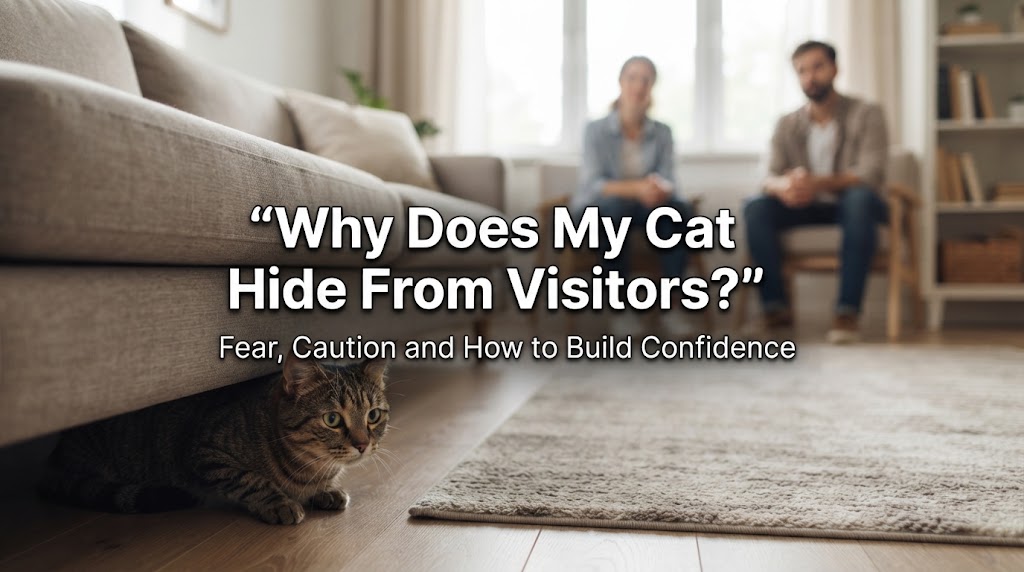
Some cats greet every visitor at the door; others disappear before the doorbell stops ringing. Hiding is a normal safety strategy, especially for cats that are cautious by temperament, had limited early social exposure or have learned that guests predict noise and unwanted handling. The goal is not to force sociability. It is to give the cat enough control that the presence of visitors becomes less threatening over time.
Quick Answer
Prepare a quiet safe space before guests arrive and let your cat choose whether to use it. Ask visitors to ignore the cat at first—no reaching, staring or following. If the cat approaches, allow sniffing and offer a tossed treat rather than direct handling. Repeated calm experiences can build confidence. A cat that suddenly begins hiding from familiar people or also shows appetite, pain or activity changes should be checked by a veterinarian.
Why Guests Can Feel Threatening
Unfamiliar scent and movement
Visitors bring new voices, footwear, perfumes and movement patterns into the cat's territory. A cautious cat may prefer to watch from a protected location until the environment feels predictable.
Past forced interactions
Being pulled from under a bed, passed between people or chased by excited children can teach a cat that visitors remove control.
Limited social experience
Cats differ in temperament and early experiences. A cat that had little positive exposure to varied people may need more time to accept newcomers.
Noise and household disruption
Doorbells, laughter, furniture movement and groups of people raise the intensity of the home. Hiding can be an effective coping behavior rather than a problem by itself.
A Low-Pressure Visitor Plan
Success can mean the cat remains relaxed in a safe room; greeting the guest is optional.
- Before the visit, prepare a quiet room or elevated retreat with food, water, litter and familiar bedding as appropriate.
- Ask guests to enter calmly and avoid approaching the cat's hiding area.
- If the cat stays hidden, leave it alone. Do not use food to lure it into a situation where it will then be touched.
- If the cat appears voluntarily, have the visitor turn slightly sideways and toss a treat away from themselves first.
- Let the cat choose the distance. Petting should happen only if the cat clearly solicits contact and remains relaxed.
- For repeat visitors, use short predictable sessions so the cat accumulates neutral or positive experiences.
Build Everyday Confidence
Confidence around visitors is easier when the home already offers choice and control.
- Provide elevated perches in rooms where people gather.
- Keep at least one hiding space visitors cannot invade.
- Use interactive play on ordinary days to support exploratory behavior.
- Maintain predictable feeding and rest routines around social events.
- Teach children that a hiding cat is unavailable for interaction.
What Progress Looks Like
Do not measure success only by physical closeness.
| Behavior | Interpretation | Response |
|---|---|---|
| Remains hidden but eats later | Coping cautiously | Respect space |
| Watches from doorway/perch | Curiosity increasing | Keep visitor neutral |
| Approaches, sniffs, retreats | Healthy investigation | Allow retreat |
| Hisses or freezes | Too much pressure | Increase distance |
| Sudden hiding from familiar household | Possible health/behavior change | Veterinary assessment |
Common Mistakes to Avoid
Do not drag a cat from hiding, block its retreat, pass it to visitors, punish hissing or use hunger to force an approach. Avoid letting a guest follow the cat from room to room. These strategies may produce a brief interaction while making future visits harder.
When to Get Professional Help
If visitor fear is severe enough that the cat stops eating, eliminates outside the box, injures itself trying to escape or remains distressed long after guests leave, discuss a structured plan with your veterinarian or a qualified feline behavior professional.
Related Virixoo Guides
For general hiding, read Why Does My Cat Hide Under the Bed?. For hissing at people, see Why Does My Cat Hiss at Me?.
Design Visits in Levels
Begin with the easiest version: one quiet visitor who ignores the cat for a short period. When the cat can remain relaxed, allow the visitor to toss treats from a distance. Later sessions may include the person moving normally around the room or briefly speaking to the cat. Large parties, children and noisy repair workers are advanced situations and may always be better managed with a private safe room. Confidence grows through successful repetitions, not by making the cat endure the hardest version first.
Give the Safe Room Real Value
The retreat should not be a bare bathroom used only when guests arrive. Include familiar bedding, water, an appropriate litter box, hiding and an elevated resting option where possible. Spend pleasant quiet time there on ordinary days so the room itself does not become another predictor of disruption. For some cats, choosing to stay in that room during visitors is a perfectly successful outcome.
Separate Socialization From Handling
A cat can learn that visitors are safe without ever wanting to be picked up by them. Treat being in the same room, watching from a perch or walking past a guest as valid progress. Once the cat chooses to approach, let contact remain optional. This prevents a common setback: the cat finally comes out, someone immediately reaches to pet it, and the cat learns that approaching causes loss of control.
Recovery After the Door Closes
Do not immediately pull the cat out once visitors leave. Let the home become quiet and allow the cat to reappear on its own. A predictable meal, play session or calm routine can help signal that normal territory has returned. Note how long recovery takes; steadily longer recovery suggests the visits may be too intense.
Bottom Line
Hiding is not failure. Give your cat a protected choice, reduce social pressure and let repeated calm visitor experiences build confidence at the cat's pace.