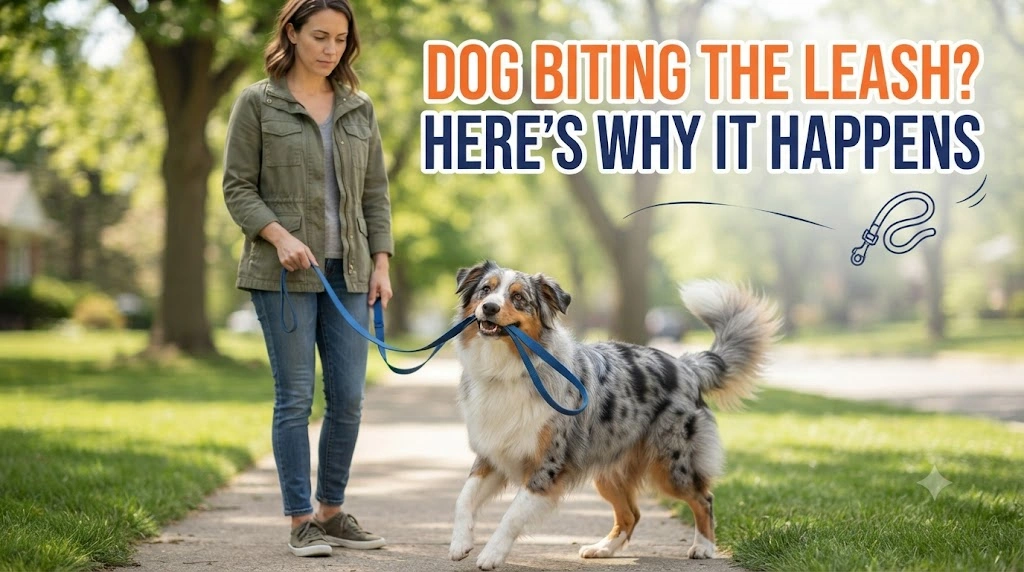
Leash biting is usually not a sign that a dog is trying to dominate the owner. It is more often linked to excitement, frustration, play, overarousal, uncertainty, or a learned response that has become rewarding. The behavior can look dramatic because the dog jumps, grabs the leash, shakes it, and may accidentally catch clothing or hands. The best solution is to identify when the behavior starts and teach a calmer action that gives the dog another way to cope.
Quick Answer
When your dog grabs the leash, avoid jerking it or turning the moment into a tug game. Pause, reduce stimulation, keep your hands still, and redirect to a simple behavior such as walking beside you, touching your hand, or carrying an appropriate toy if that is safe for the dog. Then reward calm movement. If leash biting occurs at predictable moments, change the routine before the dog becomes overaroused.
Why Dogs Bite the Leash
Puppies explore with their mouths, so early leash chewing can be simple curiosity. Adolescent dogs often bite when excitement rises faster than their self-control. Adult dogs may learn that grabbing the leash makes the owner stop, speak, pull back, or play. In other cases, leash biting appears when the dog is frustrated because it cannot reach another dog, smell, person, or destination.
The same outward behavior can therefore have different causes. Watch what happens immediately before the first grab.
Common Triggers
Beginning the walk
Some dogs become so excited when the leash clips on that they grab it before the walk begins. Calmer departures can reduce this. Ask for a simple familiar behavior, open the door only when the dog is composed enough to think, and avoid winding the dog up with repeated verbal excitement.
End of the walk
Dogs may bite the leash when they realize the walk is ending. This can be frustration rather than play. Add a predictable calm activity near home, such as a short sniffing period, so the return home does not always feel like an abrupt loss of access to the environment.
Seeing another dog
A dog that cannot approach another dog may redirect that frustration onto the leash. Increase distance before the dog reaches the point of lunging and biting. Reward attention and calm movement while the dog is still able to respond.
Fast movement and play
Running, sudden direction changes, or a swinging leash can trigger chase-and-grab behavior. Keep the leash from dangling dramatically and avoid deliberately waving it around to distract the dog.
Do Not Turn the Leash Into a Tug Toy
If you pull back hard when the dog grabs the leash, the resistance itself can be rewarding. The dog may interpret the movement as a game. Keep tension as neutral as safety allows and avoid rapid back-and-forth pulling. A leash is safety equipment, so it should not become the dog's main tug object.
Teach a Replacement Before the Problem Starts
Practice a simple behavior in a quiet place first. Useful options include hand target, eye contact, walking beside you for a few steps, or picking up an appropriate toy. Reward the dog for performing the replacement while calm. Then use it on walks before the usual leash-biting moment.
The timing matters. Once the dog is already jumping and biting intensely, learning is harder. Preventing the escalation is more effective than trying to train through peak arousal.
A Practical Trigger Plan
| Trigger | Preventive Action |
|---|---|
| Leaving the house | Pause for calm behavior before moving |
| Seeing another dog | Create distance early and reward attention |
| Turning toward home | Add a short sniffing period before ending the walk |
| Owner starts running | Keep pace predictable and leash movement minimal |
| Dog becomes overtired | Shorten the walk and add calmer enrichment instead |
Could Equipment Be Contributing?
A leash that repeatedly taps the dog's legs or a poorly fitted harness can increase irritation. Check that the harness allows comfortable movement and that the leash length fits the environment. Very long lines can create more motion and opportunities to grab in crowded areas, while very short tension can increase frustration in some dogs.
Puppies Need Simpler Expectations
Puppies have limited impulse control. Short, successful walks often work better than long outings where the puppy becomes overtired and starts biting everything. Add sniffing, rest, and age-appropriate play rather than using more walking as the only way to tire the puppy out.
What to Do During an Episode
Stay calm, stabilize your hands, and reduce movement. If safe, step on the leash close enough to limit jumping without forcing the dog's neck downward. Wait for a moment of release, then cue the trained replacement and reward it. If the dog is too aroused to respond, move to a quieter place and end the session.
Never wrap the leash around your hand, because sudden pulling can injure fingers or wrists.
When Leash Biting Becomes More Serious
If the dog redirects onto hands, clothing, or skin, the issue is no longer just a damaged leash. Seek professional help, especially if bites cause bruising or punctures. A veterinarian can also help rule out pain or medical factors when the behavior is new or unusually intense.
What Not to Do
- Do not hit or intimidate the dog.
- Do not jerk the leash repeatedly.
- Do not encourage leash tugging for fun.
- Do not wait until the dog is fully overaroused before intervening.
- Do not keep extending the walk when overtired behavior is worsening.
Build Calmness Outside Walks
Impulse control improves when the dog practices calm behavior throughout daily life. Short training sessions, food-search games, mat settling, and structured play can all help. The goal is not to suppress excitement but to give the dog more ways to handle it.
Frequently Asked Questions
Is leash biting aggression?
Usually not by itself. It commonly reflects play, frustration, or overarousal. However, redirection onto people or serious biting deserves professional assessment.
Should I use a chain leash?
A tougher leash may prevent damage but does not address the cause. Training and trigger management remain more important.
Will my puppy grow out of it?
Some puppies improve with maturity, but repeated rehearsal can make the behavior stronger. Teaching an alternative early is more reliable than waiting.
Bottom Line
Leash biting is best understood as a behavior with a trigger, not a character flaw. Identify when arousal rises, prevent the predictable moments, keep the leash from becoming a tug toy, and reward a calmer replacement. If the behavior escalates toward people or cannot be managed safely, seek qualified help.
Why Overtired Dogs Often Bite More
Many dogs become less coordinated and more mouthy when they are tired. A walk that is too long can therefore increase leash biting rather than reduce it. If the behavior appears near the end of every outing, shorten the walk slightly and add calmer enrichment at home. Sniffing and food-search activities can be mentally satisfying without pushing the dog into physical overarousal.
Track when the behavior begins. If it reliably appears after twenty minutes, finish successfully at fifteen and build duration slowly rather than allowing the same chaotic ending every day.
Why the Leash Becomes the Target
The leash is always present, moves with the dog, and often becomes tight at exactly the moment frustration rises. That makes it an easy target for redirected energy. A dog prevented from greeting another dog, chasing a squirrel, or running freely may grab the nearest moving object—the leash. Understanding that pattern helps the owner focus on the trigger rather than the leash itself.
Teach “Drop” Away From Walks
Practice releasing toys in a calm indoor setting. Offer a low-value toy, present a treat near the dog's nose, and reward the moment the dog releases. Then return the toy when appropriate. Over time, add a verbal cue. This does not magically solve leash biting, but it gives the dog a familiar release behavior that can later be used when arousal is still manageable.
Do not wait until the dog is hanging from the leash and highly excited to introduce the cue for the first time.
Use Sniffing as a Reset
Sniffing can lower the pace of a walk. If your dog begins to show early signs of overarousal—faster movement, jumping, mouthing, or scanning—move to a safe grassy area and scatter a few pieces of food for a short search. This shifts attention downward and gives the dog a task with a clear end.
If food increases excitement in your dog, use a calm pause or simple hand target instead.
What If the Dog Bites the Leash When Told “No”?
Some dogs become more aroused by repeated verbal correction. The owner's voice becomes part of the interaction, and the dog responds with more grabbing. A quieter strategy is often more effective: stop movement, wait for a moment of release, then cue a known alternative and move on.
Protect Hands and Clothing
Keep the leash short enough for safety but avoid bunching it near the dog's mouth. Do not grab close to the dog's face during an intense episode. If the dog redirects onto sleeves or hands, prioritize safety and professional guidance. Repeated accidental contact can escalate into a serious handling problem.
Why More Exercise Is Not Always the Answer
Owners often try to solve leash biting by making walks longer. For dogs that become overtired or overstimulated, this can worsen the behavior. Mental enrichment, sniffing, short training sessions, and adequate sleep can reduce the need for marathon walks.
A Weekly Training Goal
Measure progress by the number of calm walks or the point at which the dog can recover, not by expecting the behavior to disappear instantly. If the dog used to bite the leash five times on every walk and now does it once near the end, that is meaningful improvement.