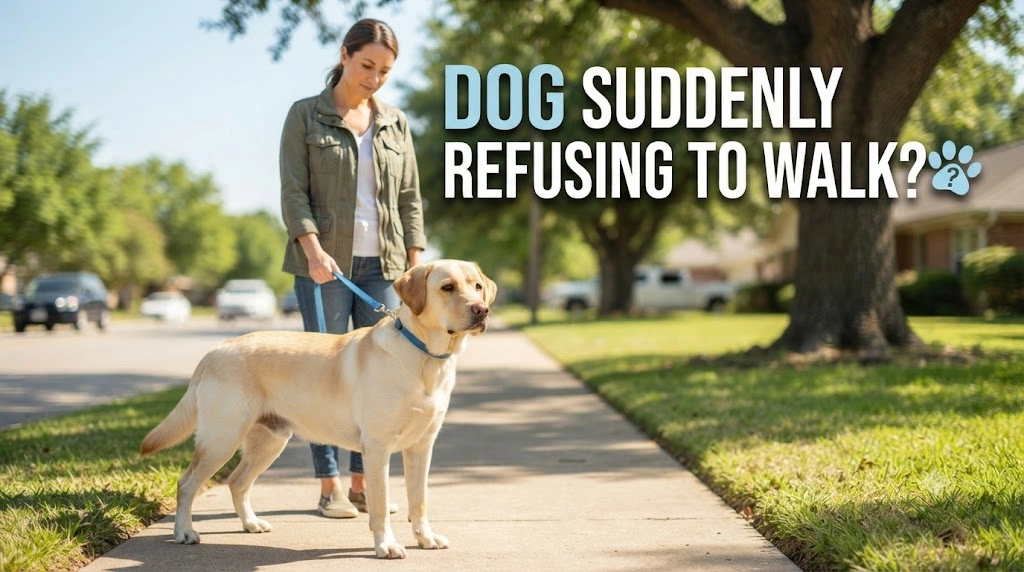
A dog that suddenly refuses to walk is communicating that something has changed. The cause may be physical discomfort, fear, heat, an unpleasant surface, leash or harness pressure, fatigue, or a specific trigger in the environment. The safest response is not to drag the dog forward. Instead, pause, look at the whole situation, and decide whether the dog is physically unable, emotionally unwilling, or simply asking for a break.
Quick Answer
If your dog suddenly stops during a walk, first check for limping, paw injury, heat stress, breathing difficulty, or obvious pain. Then look for environmental triggers such as traffic, construction noise, unfamiliar dogs, slippery surfaces, or a place where something frightening happened before. Move to a quieter area and see whether the dog can walk normally there. Contact a veterinarian if the refusal is new, persistent, painful, or accompanied by weakness, limping, swelling, collapse, or another health change.
Start With the Exact Moment the Dog Stops
The location and timing often give the first clue. A dog that walks normally for ten minutes and then suddenly stops on hot pavement may have a different problem from a dog that freezes at the front door before the walk begins. Notice whether the refusal happens at the same street corner, near a loud vehicle, on a certain surface, after a particular distance, or only when wearing specific equipment.
Also watch posture. A fearful dog may crouch, lean backward, tuck the tail, scan the environment, or try to retreat. A painful dog may shift weight, hold up a paw, move stiffly, sit abruptly, or resist turning. A tired or overheated dog may pant heavily and seek shade rather than showing fear.
Rule Out Pain Before Treating It as a Training Problem
Pain is one of the most important reasons for a sudden change in walking behavior. Check each paw for cuts, torn nails, swelling, thorns, or irritation between the toes. Watch for stiffness when standing, reluctance to jump into the car, difficulty using stairs, or a change in gait at home. Dogs with neck, back, joint, or muscle pain may walk a short distance and then stop when discomfort increases.
Do not repeatedly pull the dog forward to see whether the problem “works itself out.” If the dog is painful, forced walking can worsen the problem and can also create fear around the leash.
Could the Surface Be the Problem?
Hot pavement, sharp gravel, salted sidewalks, metal grates, wet floors, and slippery tiles can all change a dog's willingness to move. Some dogs are comfortable on grass but stop on polished concrete or shiny indoor floors. Senior dogs and dogs with orthopedic problems may be especially cautious because a slip can be painful or frightening.
If the dog immediately walks normally on a safer surface, that is useful information. Change the route rather than forcing exposure to the surface while the dog is distressed.
Fear and Environmental Triggers
Dogs can refuse to walk after hearing fireworks, construction noise, motorcycles, alarms, or other intense sounds. Some develop location-specific fear after a single bad experience, while others become more cautious gradually. A dog may also stop when another dog appears ahead, when strangers approach, or when the route becomes crowded.
Do not punish freezing or drag the dog toward the trigger. Create distance, move to a quieter route, and reward calm movement when the dog chooses to continue. If fear is severe, persistent, or expanding to more places, ask a veterinarian or qualified reward-based behavior professional for help.
Check the Harness, Collar and Leash
Equipment can become uncomfortable if it is too tight, twisted, rubbing behind the legs, or pressing on a painful area. Check fit before every walk, especially in growing puppies and dogs whose weight has changed. A dog that walks normally without a certain harness but refuses when it is worn may be reacting to fit or to a negative association with the equipment.
If your dog also resists putting the harness on, Virixoo's guide on dogs that refuse a harness can help you separate fit problems from handling sensitivity and learned avoidance.
Heat, Fatigue and Fitness
Walking tolerance changes with temperature, humidity, age, body condition, and fitness. A dog that happily walks a route in cool weather may struggle on a warm day. Brachycephalic dogs, senior dogs, overweight dogs, and dogs with heart or respiratory disease can be particularly vulnerable to heat and exertion.
Heavy panting that does not settle, weakness, vomiting, confusion, collapse, or abnormal gum color after heat exposure requires urgent veterinary attention. Do not wait for the dog to “push through” the walk.
Patterns That Help
| Pattern | What to Consider |
|---|---|
| Stops only on one surface | Heat, slipperiness, texture, or previous frightening experience |
| Stops after a certain distance | Pain, fatigue, fitness, heat, or medical limitation |
| Freezes when a trigger appears | Fear or overstimulation |
| Refuses before leaving home | Equipment sensitivity, fear, or previous negative association |
| Stops with limping or paw lifting | Physical discomfort or injury |
What to Do in the Moment
Stop pulling and give the dog a few seconds to observe. If you see no emergency sign, turn slightly away from the trigger, create more distance, or take a quieter route. Use a calm voice and reward voluntary movement. If the dog still refuses, ending the walk may be safer than escalating pressure.
For a dog that appears physically uncomfortable, keep movement minimal and arrange veterinary advice. If a paw looks injured, avoid long walks until the problem is understood.
What Not to Do
- Do not drag the dog by the leash.
- Do not use intimidation to force movement.
- Do not assume stubbornness before checking pain and fear.
- Do not keep walking a dog that appears overheated or weak.
- Do not repeatedly expose the dog to a frightening trigger at full intensity.
A Three-Day Observation Plan
For several short walks, record the route, weather, surface, equipment, distance, and exact location where the dog stops. Note whether the dog walks normally at home and whether stairs, jumping, or rising from rest have changed. This helps reveal patterns that may not be obvious from one walk.
If the refusal occurs only near one trigger, behavior may be the main issue. If it happens in many places and the dog's movement has changed at home too, physical discomfort becomes more likely.
When to Call the Veterinarian
Arrange veterinary assessment when refusal is sudden and persistent, when the dog limps, seems painful, has swollen paws or joints, tires unusually quickly, or shows weakness, appetite change, fever, coughing, or breathing problems. Seek urgent care for collapse, severe weakness, major trauma, inability to stand, severe breathing difficulty, or suspected heatstroke.
What Success Looks Like
The goal is not to make the dog complete every planned route. Success means the dog can move comfortably, safely, and without being forced. Once pain and medical problems are excluded, gradual confidence-building and better environmental management often restore normal walking.
Bottom Line
A dog that suddenly refuses to walk is giving useful information. Check pain, paws, heat, equipment, surfaces, and fear before labeling the behavior as stubbornness. Calm observation and small environmental changes often reveal the trigger, while persistent or painful refusal deserves veterinary assessment.
How to Reintroduce a Difficult Route
If pain has been ruled out and the problem is linked to a specific location, return at a lower intensity. Approach from farther away, choose a quieter time of day, and allow the dog to observe without being forced forward. Reward relaxed behavior and leave before the dog becomes stuck. Several easy successful exposures are more useful than one long session where the dog freezes for minutes.
Progress may not be linear. A dog can handle a location well one day and struggle the next because of traffic, weather, fatigue, or a new trigger. Adjust the plan to the dog in front of you rather than insisting on the same distance every time.
Fear-Based Refusal vs. Pain-Based Refusal
Fear-based refusal often changes with the environment. A dog may walk normally in the yard but freeze near traffic, a construction site, or a place where another dog previously rushed toward it. Pain-based refusal is more likely to appear across several settings and may also affect daily activities such as rising, turning, climbing stairs, or getting into the car. Neither pattern is absolute, but comparing environments helps you decide which direction deserves more attention.
If your dog refuses in only one location, try a different route at a quieter time. If the dog refuses everywhere and movement looks different at home, contact your veterinarian sooner. A dog can also have both pain and fear at the same time, especially after an injury or frightening event.
What to Check on the Paws
Inspect pads, nails, and the spaces between toes in good light if your dog tolerates handling. Look for cuts, torn nails, swelling, redness, plant material, road salt, or something stuck to the pad. Hot surfaces can make a dog stop suddenly even when the paw looks normal. If the dog pulls the paw away sharply, do not continue squeezing or probing.
After long walks, also check whether the pads are excessively worn or tender. Dogs that are newly exercising on rough surfaces may become sore even without a single obvious injury.
Why a Dog May Refuse Only on the Way Home
Some dogs stop because they have learned that turning toward home means the interesting part of the walk is ending. In that case, refusal may appear only at certain corners or when the owner changes direction. Add a predictable sniffing break near the end of the walk and vary the final few minutes so returning home does not always mean immediate loss of access to everything interesting.
Do not reward a long standoff by repeatedly turning away from home every time the dog stops. Instead, teach a calm transition using small rewards, a short sniff, then continued movement.
Why a Dog May Refuse Only at the Start
A dog that will not leave the house may have developed a negative association with something outside: traffic noise, an aggressive dog nearby, hot pavement, or a harness that predicts discomfort. Start by stepping just outside for a brief positive experience, then return indoors before the dog becomes worried. Build duration gradually.
If refusal at the door appears suddenly in a previously enthusiastic dog, check pain and health before assuming a training problem.
Senior Dogs Need a Different Walking Standard
Older dogs may still enjoy walks but need shorter distances, softer surfaces, more sniffing breaks, and slower pace. A senior dog that stops is not necessarily being difficult. Arthritis, reduced stamina, vision changes, and heat sensitivity can all change what a comfortable walk looks like. Adjust the goal to quality rather than distance.
When Refusal Is Actually a Safety Signal
Sometimes the dog notices something the owner has not yet seen: a loose dog, unusual smell, loud machinery, or unstable surface. Before insisting on movement, scan the environment. A brief pause can prevent pushing the dog into a situation that truly feels unsafe.