
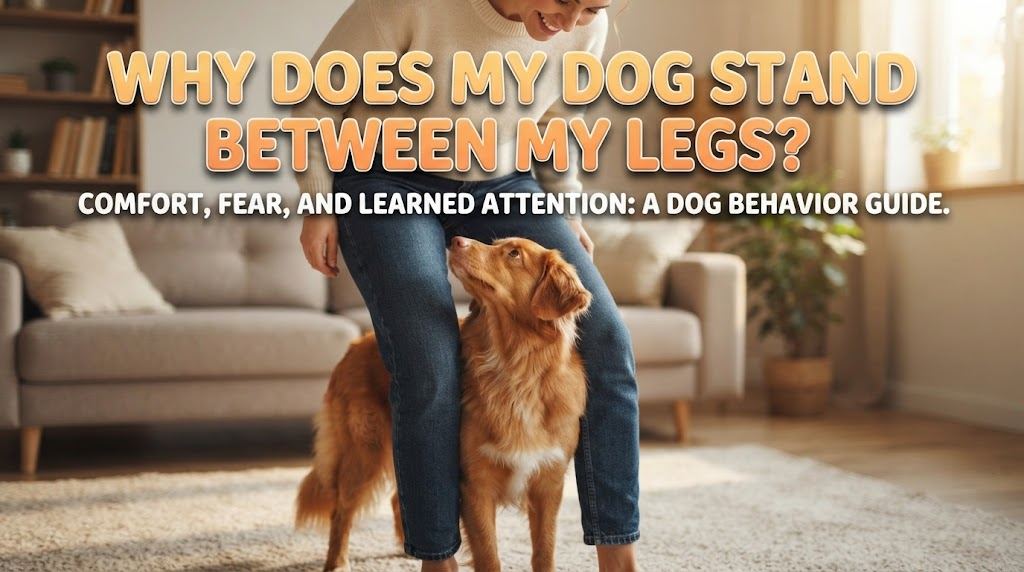
A dog standing between your legs may look clingy, protective, submissive, or affectionate depending on the story people attach to it. The behavior itself is simpler: the dog has chosen a very close, partly enclosed position.
Quick Answer
Your dog may stand between your legs for physical closeness, security, attention, warmth, or because the behavior has been rewarded before. If the dog does it mainly during thunder, crowds, unfamiliar places, or other stressful events, the position may function as a safe place. Read the whole body before deciding what it means.
Relaxed Contact vs. Fear-Based Hiding
| Relaxed contact | Possible fear or anxiety |
|---|---|
| Loose muscles | Crouched or tense body |
| Soft face and normal breathing | Panting, trembling or lip licking |
| Moves in and out freely | Tries to remain hidden behind you |
| Occurs during ordinary social time | Occurs around specific triggers |
The Position Can Be Reinforced by Attention
If standing between your legs reliably leads to petting, talking, or protection from another pet, it can become a familiar request. That is not inherently a problem. It only needs changing when it is unsafe, intrusive, or linked with distress.
Safety Matters With Large or Fast-Moving Dogs
A dog weaving between legs can trip a person, especially on stairs, near traffic, in a kitchen, or around someone with reduced balance. Teach an alternative station such as standing at your side or settling on a mat. Reward the alternative rather than physically shoving the dog away.
If the Dog Uses You as a Shield
When the behavior appears around strangers, other dogs, loud noises, or unfamiliar environments, do not force the dog out to “face the fear.” Increase distance from the trigger and allow the dog to recover. Repeated intense fear is a reason to seek help from a veterinarian or qualified reward-based behavior professional.
Do Not Interpret the Position as Dominance
AVSAB cautions against relying on dominance explanations for everyday dog behavior. It is more useful to identify the immediate context, emotional state, learning history, and consequences of the behavior.
Related Virixoo Guides
If your dog seeks side-to-side body contact, read why dogs lean on people. If the dog places its body above you while you sit, see why dogs may stand over a seated owner. If fear shows up as refusal to cross a threshold, read why dogs may avoid doorways.
Bottom Line
Standing between your legs is best understood through context. A relaxed dog seeking contact is different from a fearful dog using your body as cover. Keep the behavior safe, respect fear signals, and reward a practical alternative when needed.