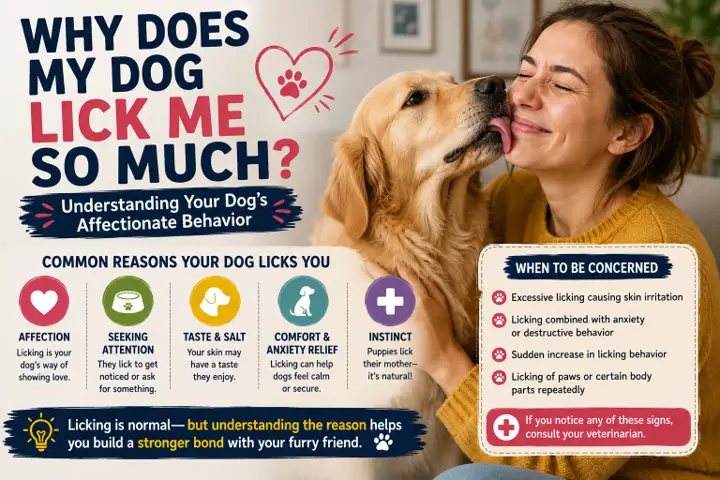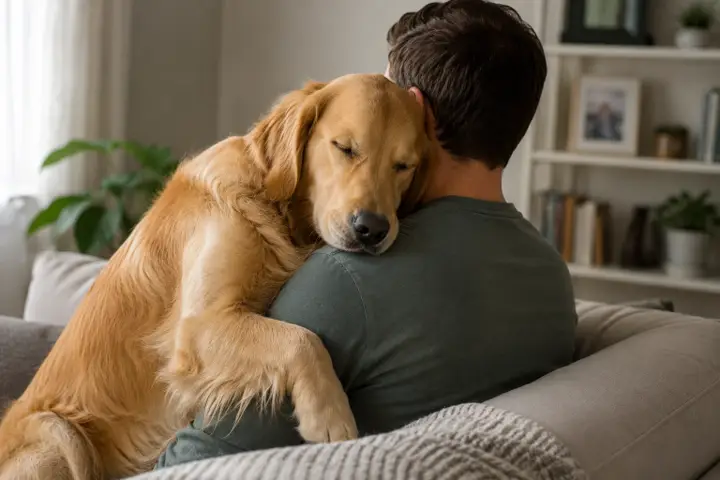
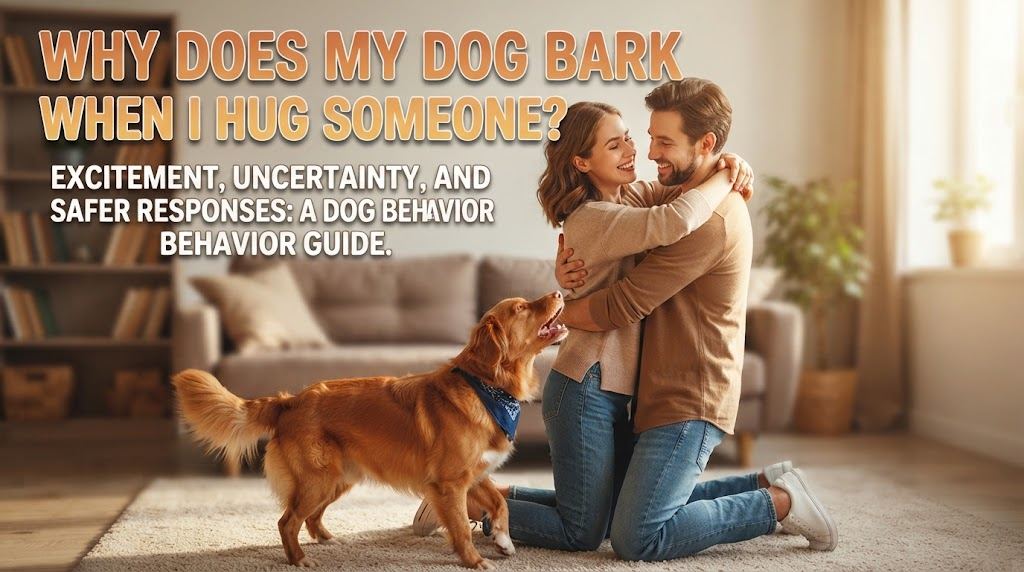
When you hug a partner, child, or friend and your dog immediately barks, it can look like jealousy. That is only one human interpretation, though. A hug changes posture, distance, facial position, movement, and attention all at once, so several different motivations can produce the same bark.
Quick Answer
Your dog may bark when you hug someone because the close contact is exciting, confusing, uncomfortable, or has become a reliable way to get attention. Some dogs may also become tense around access to a favorite person. Do not label the behavior from the bark alone. Look for loose versus stiff posture, distance-seeking, growling, jumping, relaxed recovery, and whether the dog can disengage.
Why Human Hugs Can Look Unusual to Dogs
People often face each other closely, wrap arms around one another, lean in, and temporarily restrict movement during a hug. Dogs do not need to understand the social meaning of that gesture for it to become interesting or uncomfortable. A dog that has little experience with animated human contact may bark simply because the scene is intense and unfamiliar.
Excitement and Concern Can Look Similar at First
| More consistent with excitement | More consistent with discomfort or concern |
|---|---|
| Loose, wiggly body | Stiff body or forward weight shift |
| Playful bouncing or loose movement | Hard stare, freezing, growling, or blocking |
| Can easily move away and settle | Escalates as people get closer |
| Recovers quickly when interaction ends | Remains tense after the hug stops |
Attention Can Reinforce the Barking
If barking makes both people stop hugging, look at the dog, speak to it, pet it, or hand over a toy, the dog can learn that barking changes the social scene. That does not mean the dog planned the behavior strategically. It simply means the consequence made repetition more likely.
Do Not Test the Dog by Repeating Bigger Hugs
If your dog becomes tense, do not stage repeated embraces to “see what happens.” That can rehearse barking or increase fear. Create distance instead. For dogs that stay comfortable enough to learn, brief low-intensity interactions can be paired with calm reward-based behavior such as settling on a mat.
What to Do During Real-Life Hugs
- Give the dog enough space that it does not feel trapped between people.
- Use a gate, mat, or comfortable resting place when greetings become busy.
- Reward calm behavior before barking starts.
- Avoid shouting, leash corrections, shock, prong, or other aversive responses.
- If the dog stiffens, growls, snaps, guards access to a person, or has bitten, get qualified professional help.
When a Sudden Change Deserves a Veterinary Check
A dog that previously ignored hugs but suddenly becomes irritable around touch or movement may be reacting to pain or another health change. Merck notes that medical causes, especially pain, should be considered when behavior changes abruptly. Watch for stiffness, reduced activity, sensitivity to handling, sleep changes, appetite changes, or other new signs.
Related Virixoo Guides
For barking in other contexts, read why dogs bark and how to identify the trigger. If your dog seeks body contact, compare why dogs lean on people. If close interaction leads to a belly-up posture, see what rolling onto the back can mean.
Bottom Line
Barking during a hug is a context-dependent response, not proof of jealousy, dominance, or protection. Read the whole dog, reduce intensity when the dog is uncomfortable, and use reward-based management rather than confrontation.