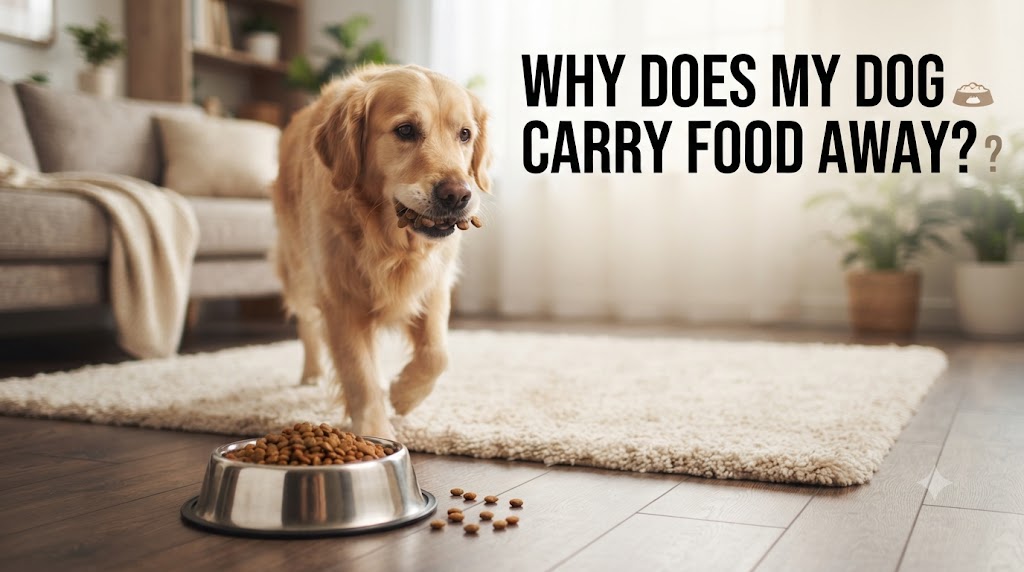
If your dog takes a mouthful of food, walks away from the bowl, drops it on a rug, and then eats it, the behavior is often harmless. Many dogs simply prefer eating in a quieter, more secure, or more comfortable spot. The important question is not “Why is my dog being weird?” but “Is my dog eating normally, comfortably, and safely?” A long-standing habit in a healthy dog is very different from a sudden change accompanied by poor appetite, painful chewing, weight loss, or tension around other pets.
Quick answer
Start by watching one complete meal without interrupting. Notice where your dog carries the food, who is nearby, whether the bowl moves or makes noise, and whether the dog eats more calmly after leaving the feeding area. Try a stable bowl on a non-slip surface in a quiet location and feed pets separately. If the behavior is new and comes with dropping food, chewing on one side, bad breath, drooling, facial swelling, vomiting, or reduced appetite, arrange a veterinary examination.
The destination usually gives the first clue
A dog that carries kibble from tile to carpet may prefer better traction. A dog that walks into another room may be creating distance from people, children, appliances, or another pet. A dog that carries food to a bed may have turned that spot into a comfortable mealtime routine. Where the dog goes often tells you more than the act of carrying food itself.
Observe body language as well. A relaxed dog may move at an easy pace, eat normally, and return for another mouthful. A worried dog may glance over its shoulder, move quickly, freeze when someone approaches, or rush to swallow. That difference matters because one pattern is a preference while the other may signal social pressure.
Common reasons dogs move food away from the bowl
A busy feeding area
Some dogs dislike eating where people constantly pass, doors open, appliances run, or children play. Moving the bowl to a quieter corner may reduce the behavior immediately. A calm feeding area is especially useful for sensitive dogs, recently adopted dogs, and dogs that have learned to guard resources.
Competition with another pet
Competition does not always look like a fight. One dog may stare at the other, hover nearby, finish first and approach the second bowl, or block an exit. The less confident dog may quietly carry food away rather than challenge the other dog. Separate feeding rooms or secure barriers are usually safer than forcing dogs to eat side by side.
The bowl itself is unpleasant
A light metal bowl may slide across tile or clang when tags touch the rim. A narrow bowl can be awkward for a broad muzzle. A dirty bowl can retain odors. A simple test is to use a clean, heavy, appropriately sized food-safe bowl on a non-slip mat. If the dog suddenly stays near it, the equipment was probably part of the issue.
A learned habit
Dogs repeat routines that have worked for them. If carrying food to the living room has always meant peace and comfort, the habit can continue even after the original reason disappears. A habit is not automatically a problem if the dog is eating enough, maintaining weight, and not creating conflict or hygiene issues.
Could this be resource guarding?
Carrying food away is not the same thing as guarding it. Resource guarding may include freezing, hard staring, hovering over the food, growling, snapping, or rapidly swallowing when someone comes close. Do not repeatedly take food away or put your hand into the bowl to “teach” the dog who owns it. Those tactics can increase anxiety around meals.
Instead, reduce pressure. Give the dog a protected feeding area, keep children away while the dog eats, and remove other pets from the space. If guarding is escalating or has caused bites, work with a veterinarian or qualified reward-based behavior professional.
When mouth pain changes the picture
A hungry dog with dental pain may still approach food but handle it differently. Watch for kibble falling from the mouth, chewing only on one side, refusing hard pieces, pawing at the face, bad breath, drooling, blood on toys, or swelling around the jaw. A fractured tooth, gum disease, oral injury, or another painful problem can make a dog pick up food, move it, and then struggle to eat.
Do not force open a painful mouth. A normally gentle dog can bite when hurt. If chewing has changed suddenly, a veterinary oral examination is safer than repeated home inspection.
Check whether your dog is actually eating enough
Measure the daily ration for several days. If you simply fill the bowl whenever it looks empty, it is difficult to know how much your dog is consuming. Separate pets during this period so one animal cannot finish another’s meal. Track body weight, energy, stool quality, and appetite. The behavior matters less if intake and body condition remain normal.
For puppies, accurate portions and growth monitoring are especially important. See Virixoo’s guide to how much a puppy should eat for age-appropriate feeding decisions.
A practical three-meal test
| Meal | Change | What to watch |
|---|---|---|
| 1 | Use the usual setup | Where the dog carries food and who is nearby |
| 2 | Move to a quiet room with a stable bowl | Whether carrying decreases |
| 3 | Feed completely separated from other pets | Whether the dog stays at the bowl |
Keep the food and portion the same during this short test. If you change the food, bowl, room, schedule, and treats all at once, you will not know which change mattered.
Flooring is an overlooked clue
Some dogs prefer eating on carpet because slippery flooring makes them feel unstable. This becomes more relevant in senior dogs or dogs with arthritis, weakness, or previous orthopedic injury. If your dog also hesitates on tile, struggles to turn, avoids stairs, or takes longer to stand, mention the pattern to your veterinarian. The food behavior may be the first place you noticed a mobility issue.
How to reduce the habit without conflict
If the behavior is harmless but messy, make the chosen eating area easier to manage. Move the bowl closer to the preferred quiet spot, place a washable mat under it, and keep other pets away. Avoid chasing the dog or repeatedly carrying pieces back to the bowl. Calm management is usually more effective than correction because the behavior often serves a comfort function.
What not to do
- Do not chase a dog that carries food away.
- Do not force pets to eat together.
- Do not punish growling around food.
- Do not keep switching foods when the problem is clearly location-related.
- Do not ignore sudden chewing difficulty, weight loss, or appetite change.
When to call a veterinarian
Arrange an appointment when carrying food begins suddenly and your dog also eats less, loses weight, drops food, chews abnormally, has bad breath, drools, vomits, or seems painful. Seek prompt help for facial swelling, significant oral bleeding, inability to swallow, choking, or severe pain. Breathing difficulty, collapse, or blue-gray gums is an emergency.
What to record before the visit
A short video of a normal meal can be useful if it can be taken without disturbing the dog. Note when the behavior began, whether hard and soft foods are affected equally, whether water drinking changed, and whether the dog favors one side of the mouth. Mention recent dental procedures, chewing on hard objects, new medications, or any change in body weight.
Frequently asked questions
Why does my dog take one piece of kibble at a time?
Some dogs simply prefer eating slowly or carrying small amounts to a comfortable spot. A sudden change in chewing or appetite deserves closer attention.
Should I move the bowl to where my dog eats?
If the location is safe, clean, quiet, and practical, moving the bowl there is a reasonable experiment.
Does carrying food mean my dog dislikes the food?
Not necessarily. A dog may like the food but dislike the bowl, floor, noise, or social environment.
Bottom line
Most dogs that carry food away from the bowl are choosing a more comfortable place to eat. Improve the environment before trying to correct the behavior. The key questions are whether your dog feels safe, eats enough, maintains healthy weight, and chews without pain. If those change, the behavior becomes a useful health clue rather than just a quirky habit.
One-week monitoring plan
For one week, keep the feeding setup consistent and record whether your dog carries every mouthful or only the first few pieces, whether the behavior changes when alone, and whether the amount eaten remains stable. Note any change in body weight, stool, energy, and willingness to chew hard treats. A predictable pattern in a healthy dog is reassuring; a progressive change is more useful evidence for a veterinary visit.
Do not turn the record into constant supervision. Quiet observation is enough. The goal is to identify patterns without making the dog more self-conscious around food.
How to decide whether to monitor or call
Use your dog’s normal baseline as the reference. A mild, familiar pattern in a comfortable dog is very different from a new or rapidly changing problem. With dog carrying food away from bowl, contact a veterinary professional sooner when pain, weakness, bleeding, vomiting, breathing changes, appetite loss, or rapid progression appears. Online guidance can organize what you observe, but it cannot replace an examination when your dog is becoming unwell.
When you do call, give a simple timeline: when the change began, whether it is getting better or worse, what other symptoms are present, and what medications or recent exposures may be relevant. Clear information helps the veterinary team triage the situation efficiently.