
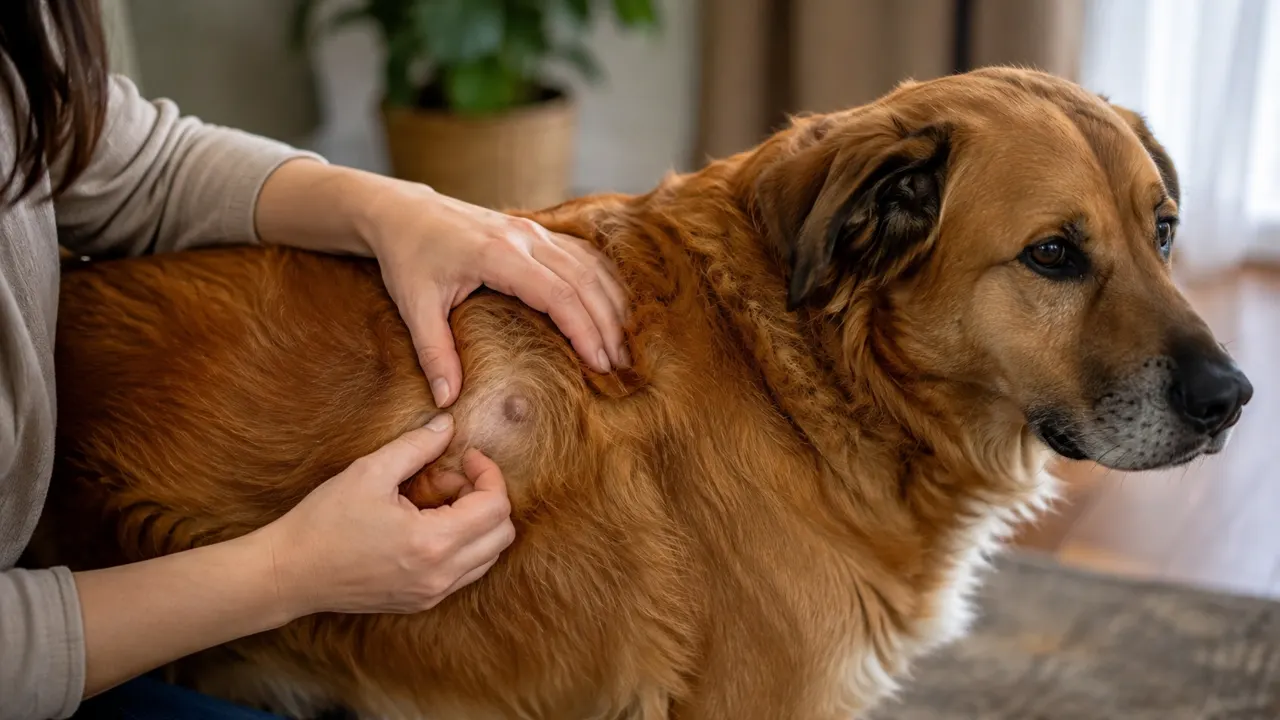
Lumps in dogs can be benign or serious, and appearance alone cannot reliably identify them. Learn what to record and why sampling is often needed[cite: 19].
Quick Answer
A lump under the skin cannot be reliably identified by touch or appearance alone[cite: 19]. Record its location and size and arrange examination for a new or changing mass; sampling with a needle or other testing is often needed to determine what it is[cite: 19].
What to Look For
Measure the lump in two dimensions, photograph it with a ruler for scale, and note location, texture, mobility, pain, skin changes, and growth[cite: 19]. Do not squeeze, lance, or repeatedly manipulate it[cite: 19].
Common Causes
1. Lipoma
Fatty masses are common in adult dogs and are often soft and movable, but feel alone cannot confirm that a lump is a lipoma[cite: 19].
2. Cyst or other benign skin mass
Some cysts and benign growths remain small and stable, while others become inflamed or rupture[cite: 19]. Identification still requires veterinary assessment[cite: 19].
3. Abscess or inflammatory swelling
Pain, warmth, redness, rapid enlargement, or discharge can suggest inflammation or infection rather than a stable benign mass[cite: 19].
4. Enlarged lymph node
A lump in a lymph-node location may reflect local or systemic disease and should be interpreted with the dog's overall examination[cite: 19].
5. Tumor
Some tumors are harmless and others are serious; size, firmness, and appearance cannot reliably separate them, which is why sampling is valuable[cite: 19].
What You Can Do Safely
Measure the lump in two dimensions, photograph it with a ruler for scale, and note location, texture, mobility, pain, skin changes, and growth[cite: 19]. Do not squeeze, lance, or repeatedly manipulate it[cite: 19].
When to Contact a Veterinarian
Every new or changing lump deserves veterinary assessment rather than visual diagnosis[cite: 19]. Faster evaluation is appropriate for rapid growth, pain, ulceration, bleeding, fixation to deeper tissue, or illness elsewhere in the body[cite: 19].
What to Tell Your Veterinarian
Share when the problem began, how it has changed, whether it affects one area or several, and any photos that document progression[cite: 19]. Include recent medications, parasite prevention, grooming, diet changes, swimming, travel, outdoor exposure, and other new symptoms[cite: 19].
Related Virixoo Guides
Why Does My Dog Have a Skin Rash? Common Causes and Warning Signs[cite: 19]. Does My Dog Have Allergies? Signs, Common Triggers and What to Do[cite: 19].
Bottom Line
Lumps in dogs can be benign or serious, and appearance alone cannot reliably identify them. Learn what to record and why sampling is often needed[cite: 19]. The pattern and accompanying signs matter more than appearance alone, and persistent or worsening problems deserve professional assessment[cite: 19].