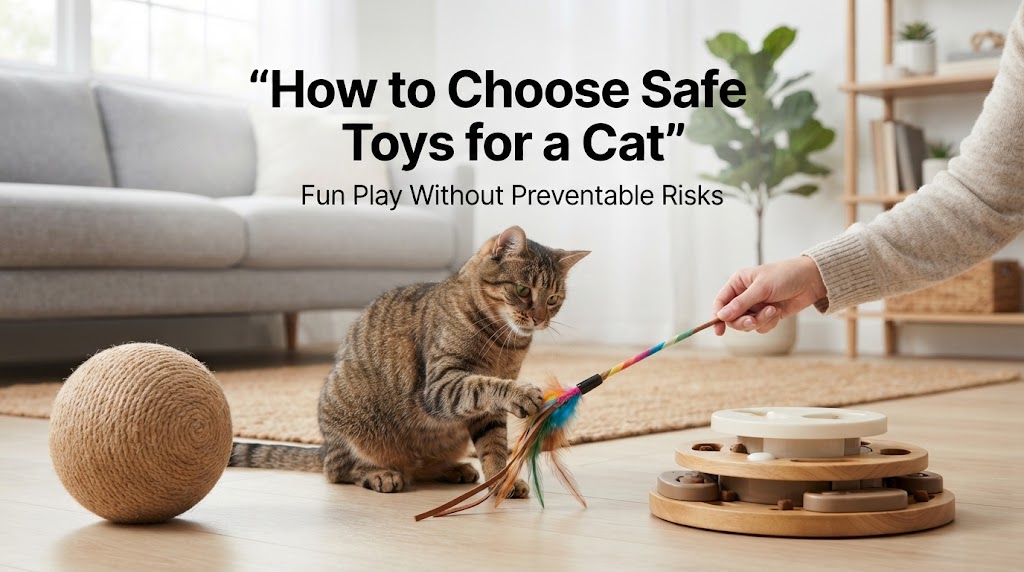
The best cat toy encourages natural stalking, chasing, pouncing or problem-solving without adding an avoidable ingestion, strangulation or fall hazard. Price and technology are not good safety tests: a cardboard box can be excellent enrichment, while an elaborate toy with loose strings or detachable pieces may be risky. Toy choice should consider the individual cat's chewing style, strength and tendency to swallow objects, and it should change as the toy becomes worn.
Quick Answer
Choose sturdy toys that are too large to swallow whole and inspect them regularly for loose feathers, bells, eyes, string, elastic or broken plastic. Keep wand toys, ribbon, yarn and other linear materials for supervised play only and put them away afterward. Give the cat a chance to capture the toy during interactive hunting games. Rotate toys to maintain novelty and count food dispensed from puzzle toys within the daily ration.
What Makes a Cat Toy Safer
Size and durability
A toy should not break into pieces your cat can swallow. Cats that chew aggressively need especially durable options and more frequent inspection.
No accessible linear material when unsupervised
String, yarn, ribbon, thread and detached wand-toy cords can be swallowed as linear foreign bodies, which can seriously injure the digestive tract. Store them after play.
Movement that supports natural play
Interactive toys are most satisfying when they move like prey—away from the cat, behind objects and in short bursts—and when the cat is allowed to catch them.
A safe play environment
A toy can become risky if the cat launches into a glass table, unstable shelf or open stairwell while chasing it. Clear the play zone before high-speed sessions.
Appropriate challenge
Food puzzles and problem-solving toys should be easy enough that the cat can succeed. Frantic attempts or abandoning the puzzle can mean the task needs to be simplified.
A Five-Minute Toy Safety Audit
Inspect toys as if you expect the cat to chew, pull and throw them.
- Look for loose seams, cracked plastic, exposed wire and detachable decorations.
- Pull gently on feathers, bells, glued eyes and tails; retire the toy if parts are loosening.
- Put string and wand toys in a closed drawer or cabinet after supervised play.
- Check electronic toys for damaged battery compartments and exposed cords.
- Remove toys small enough for your cat to swallow or lodge in the mouth.
- Review the surrounding play area for unstable furniture, open windows and breakable objects.
- Rotate a small set of safe toys while storing the rest to preserve novelty.
Low-Cost Enrichment Can Be Excellent
Simple does not mean boring when the activity matches feline behavior.
- Cardboard boxes with tape, staples and loose packing material removed.
- Paper bags with handles removed.
- Sturdy balls too large to swallow.
- Food puzzles introduced at an easy level.
- Supervised wand play.
- Safe tunnels and stable scratching structures.
Toy Type and Supervision
Some toys are appropriate only while you are actively present.
| Toy | Main Risk | Use |
|---|---|---|
| Wand/string toy | Linear material ingestion | Supervised only |
| Small loose ball | Swallowing if undersized | Choose size carefully |
| Battery toy | Broken compartment/cord | Inspect often |
| Food puzzle | Extra calories/frustration | Measure food, start easy |
| Cardboard box | Staples/tape/chewed pieces | Prepare and inspect |
Common Mistakes to Avoid
Do not leave yarn, dental floss, ribbon or fishing-line-style toys accessible after play. Avoid assuming a toy remains safe forever; chewing and age can expose parts. Do not use your hands and feet as prey toys if you want to prevent biting and clawing people.
If Your Cat Swallows Part of a Toy
Contact a veterinarian promptly if you know or suspect that your cat swallowed string, ribbon, thread, a needle, a battery, a sharp piece or another foreign object. Do not pull visible string from the mouth or anus because it may be anchored internally. Repeated vomiting, appetite loss, abdominal pain or lethargy after possible ingestion needs urgent assessment.
Related Virixoo Guides
For daily play ideas, see How to Keep an Indoor Cat Mentally Stimulated. For cardboard chewing, read Why Does My Cat Bite Cardboard?.
Match Toys to the Cat's Play Style
A cat that gently bats a plush mouse may be safe with toys that would not survive a powerful chewer. Watch what your cat actually does: does it tear seams, chew feathers, carry objects, swallow pieces or become obsessed with elastic? Choose materials and supervision based on that behavior. Kittens may also change play style as they grow, so a toy that was appropriate a month ago should still be inspected rather than automatically remaining in the safe pile.
Create a Toy Storage Routine
Use a closed container for wand toys, string, ribbon and small interactive pieces so “supervised only” has a practical meaning. Before bed or leaving home, do a quick floor check and put those items away. Store toys dry and clean; discard items that are heavily soiled, chewed or impossible to inspect. Rotation then serves two purposes at once: it preserves novelty and gives you a regular opportunity to examine every toy for damage.
Retire Toys Before They Fail
Do not wait for a feather, bell or plastic piece to detach completely. Fraying cord, exposed stuffing, loose stitching or cracked plastic is enough reason to remove a toy. Replacement is cheaper and safer than discovering a missing part after the cat has been playing unsupervised.
Bottom Line
A safe toy survives the way your cat actually plays with it. Match size and durability to the individual, supervise linear toys, inspect for wear and make the environment around the game part of the safety check.