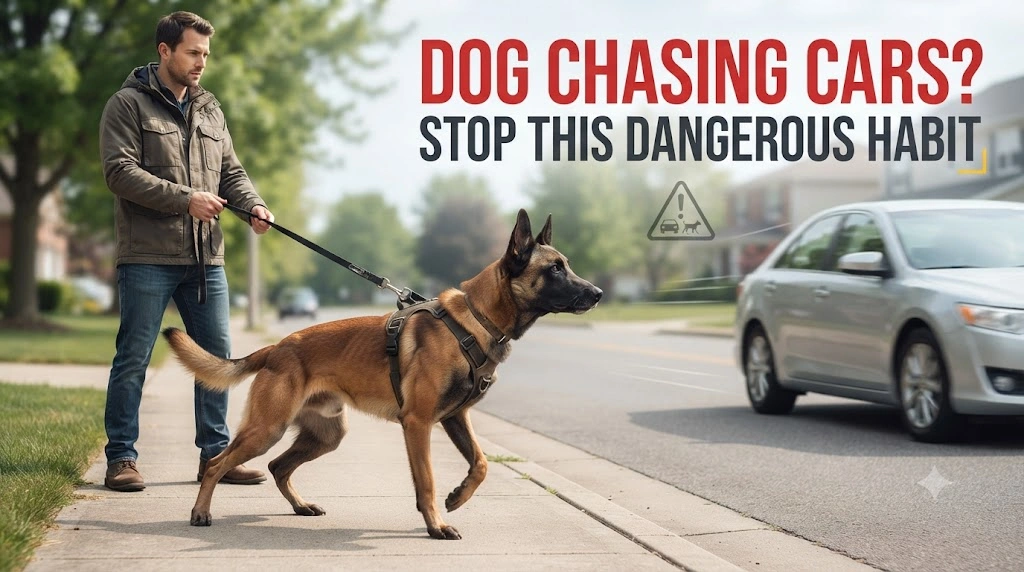
Car chasing is a high-risk behavior because one mistake can place a dog directly in traffic. Dogs may react to vehicles because of motion sensitivity, predatory chase tendencies, fear, frustration, herding-style behavior, or a learned habit. The first goal is not training near fast traffic. The first goal is preventing access to the road while you build calmer responses at a safe distance.
Quick Answer
Use secure equipment, avoid off-leash access near roads, and choose routes where you can maintain distance from moving vehicles. Begin training far enough away that your dog can notice a car without lunging. Reward calm observation, turning toward you, and moving with you. If the dog cannot eat, respond, or disengage, you are too close.
Why Motion Triggers Chasing
Fast-moving objects can activate chase behavior in many dogs. For some, the movement is exciting. For others, vehicles are frightening and lunging is an attempt to make them go away. Herding breeds may be especially sensitive to movement, but any dog can develop the behavior. The emotional reason matters because a fearful dog and a highly excited dog may need different training emphasis.
Safety Comes Before Training
Use a well-fitted harness or secure collar appropriate for your dog, inspect clips and stitching regularly, and avoid retractable leashes near roads. Keep enough distance from traffic that a sudden lunge cannot reach the roadway. If your dog is strong enough to pull you off balance, choose training locations with physical barriers or much greater distance.
Never rely on verbal recall around traffic while the behavior is unresolved.
Find the Dog's Threshold
The training distance should allow the dog to notice a vehicle while still being able to eat, respond to a simple cue, and move away with you. If the dog freezes, stares intensely, lunges, barks, or ignores food, increase distance. Training at threshold is not weakness; it is how learning remains possible.
Teach an Emergency Turn
Practice a rapid but calm turn away from a trigger in a quiet area before using it roadside. Say a consistent cue, turn 180 degrees, and reward the dog for moving with you. Build speed gradually. This behavior can help you leave when a large truck, motorcycle, or unexpected vehicle appears too close.
Reward Disengagement
Instead of demanding that the dog never look at vehicles, allow a brief glance from a safe distance. The moment the dog turns away, looks back at you, sniffs, or relaxes, reward that choice. Over time, the dog learns that seeing a moving vehicle predicts calm interaction with you rather than a chase.
Do Not Practice Beside Heavy Traffic
High-volume roads create constant triggers with little recovery time. Start in quieter places where individual cars pass occasionally. An empty parking lot edge, quiet residential street, or distant viewpoint can provide more control. Increase difficulty slowly only after the dog is consistently successful.
Common Trigger Patterns
| Trigger | Possible Meaning |
|---|---|
| Only fast cars | Motion intensity may be the main trigger |
| Motorcycles or loud trucks | Noise and movement may combine |
| Cars approaching head-on | Fear or pressure from direct movement |
| Cars moving away | Chase motivation may be stronger |
| Reaction only from the yard | Barrier frustration or territorial context may contribute |
Yard Chasing Still Matters
A dog that runs the fence line after every passing car is rehearsing the same pattern repeatedly. Use visual barriers, supervised yard time, or move the dog away from the road-facing area. Reducing rehearsal is part of training because behavior becomes stronger when practiced hundreds of times.
What About Bikes and Joggers?
Dogs that chase cars may also react to bicycles, scooters, skateboards, or runners. Treat each category as its own trigger. A dog that can ignore slow cars may still react strongly to a fast bicycle. Build skills separately and maintain safe distance.
What Not to Do
- Do not train off leash near roads.
- Do not punish lunging beside traffic.
- Do not force the dog closer to vehicles to “get used to them.”
- Do not rely on a retractable leash near moving traffic.
- Do not allow repeated fence-line chasing if you can prevent it.
When Fear Is Part of the Problem
If the dog crouches, trembles, tucks the tail, or tries to flee before lunging, fear may be driving the behavior. Increase distance and reduce exposure intensity. A qualified reward-based professional can help design a gradual desensitization plan.
When to Seek Professional Help
Get help if the dog has escaped toward traffic, is strong enough to overpower the handler, redirects bites onto the leash or person, or cannot recover after vehicles pass. A veterinarian can also assess whether pain, sensory changes, or anxiety are contributing.
Bottom Line
Car chasing is a safety problem first and a training problem second. Prevent access to traffic, work below the dog's reaction threshold, reward disengagement, and teach a reliable emergency turn. Progress should happen at a distance where the dog can think, not at the edge of a dangerous road.
How to Practice Without Real Traffic Pressure
You can build core skills far from roads. Practice the emergency turn, hand target, name response, and walking with you in a quiet park or large open area. Once these behaviors are fluent, introduce distant vehicle movement while keeping enough space for the dog to succeed. Training the skills separately makes them easier to use under pressure later.
Always prioritize physical safety over a perfect training session. If the environment becomes suddenly busier, leave rather than trying to prove the dog can handle it.
Why Punishment Near Traffic Can Backfire
If a dog already fears moving vehicles, harsh leash corrections or shouting can make the appearance of cars predict even more discomfort. The dog may become more vigilant and reactive. If the behavior is driven by excitement, punishment can still add arousal and make the roadside environment more chaotic.
Distance and controlled exposure are safer tools. The dog should learn that vehicles can pass while nothing bad happens and that disengaging from them is rewarding.
Use Stationary Observation
Some dogs learn better when they are not walking at the same time. Find a safe location far from traffic, stand or sit with the dog, and let occasional vehicles pass at a distance. Reward calm glances and voluntary orientation back toward you. Keep sessions short.
Build a Strong Name Response
Practice the dog's name in quiet environments until turning toward you is automatic. Then add mild distractions. A strong orientation response gives you a simple tool before a vehicle gets too close. Do not repeat the name over and over when the dog is already fully locked onto a car; increase distance instead.
What If the Dog Chases From Inside the Car?
Some dogs bark and lunge at passing vehicles through windows. Use visual barriers, secure restraint, and greater distance from windows when parked. If the dog rehearses chasing from inside a moving car, reducing visual access may help lower arousal. Safety restraint is important regardless of behavior.
Rural Roads Are Not Automatically Safer
Quiet roads may have fewer vehicles, but cars can travel faster and there may be no sidewalk or barrier. Maintain secure equipment and enough distance that a sudden lunge cannot reach the road. Never assume a road is safe because traffic is infrequent.
How to Progress Training
Increase only one challenge at a time: either reduce distance, increase vehicle frequency, or introduce noisier vehicles. If you change all three at once, the dog may cross threshold quickly. Successful training should look almost boring.
What If the Dog Escaped and Chased Before?
A history of successful chasing increases urgency. Improve physical containment immediately—fences, gates, doors, leashes, and supervision—before relying on behavior work. The dog should not get another opportunity to reach traffic while training is still in progress.